

There are several sites out there offering comprehensive lists of commentaries by various criteria and this is emphatically not one of them. Nor is it a list necessarily of the best or greatest. These are the books I have most valued, enjoyed, or found memorable.
Each, in its particular way, shines a light, moves the heart, provokes one’s thoughts.
5 Books: Into The Old Testament
-
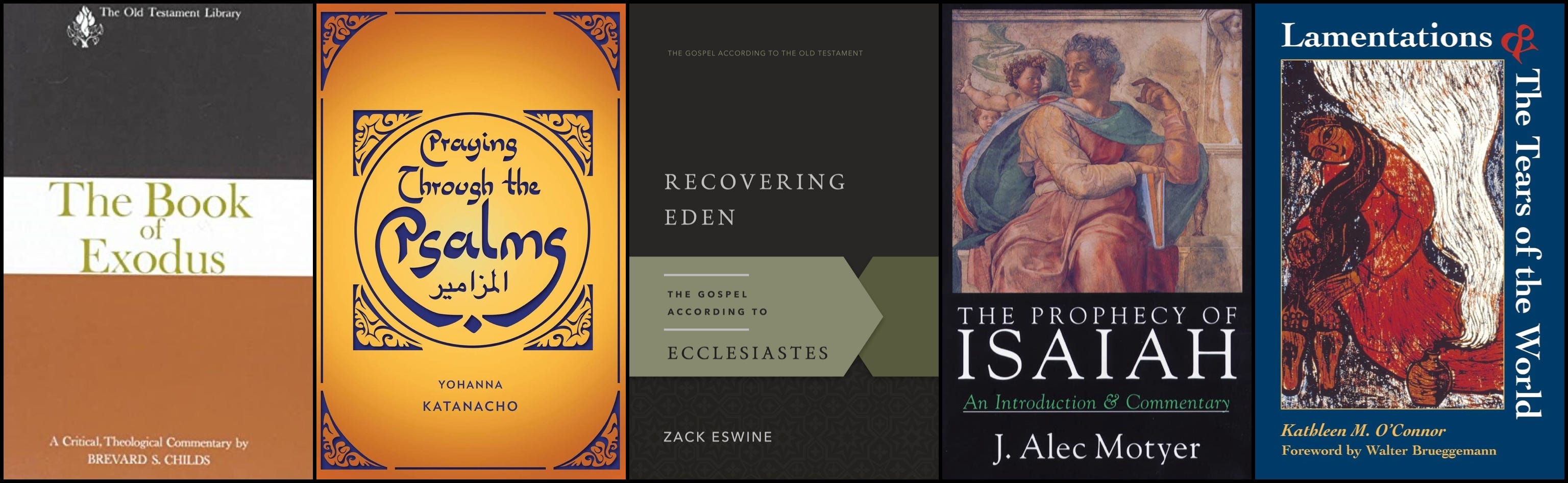
Book of Exodus (OTL) by Brevard S Childs: This has become rather a classic in the 50 or so years since the Yale professor published it. Best known for taking a canonical approach to interpretation, Childs’ is a lucid, brilliant and constantly fascinating commentary on this foundational book.
-
Praying through the Psalms by Yohanna Katanacho: Not a commentary at all, this; Yohanna Katanacho is a Palestinian Christian theologian who accepts the extent of the biblical canon despite some of the existential challenges arising from the aggressive Zionism that gets justified from it. Each psalm inspires a contemporary prayer of his own. Very powerful.
-
Recovering Eden (Gospel acc. to Ecclesiastes) by Zack Eswine: Full disclosure, Zack supervised my doctoral thesis and is a valued friend. He’s a gifted preacher and apologetic and cultural bridge-builder. So Ecclesiastes is the perfect means for displaying this. Superb.
-
The Prophecy of Isaiah by J. Alec Motyer: Alec Motyer was that rare combination of a bona-fide OT scholar and warm-hearted pastor. Isaiah was his life’s work and this, his magnum opus, was one of several that he wrote on the prophet. I well remember one of its launch events in Oxford. Motyer is partial to finding chiasms around many a corner and he impishly divides the book after ch38. But he is consistently insightful. Marvellous!
-
Lamentations and the Tears of the World by Kathleen M. O’Connor: Jeremiah’s Lamentations can feel intimidating. After all, who wants their nose buried in misery? But not only does this oversimplify the biblical book, it also ignores the fact that we must all face seasons of acute pain. O’Connor does a remarkable job in showing how compelling and necessary Lamentations is. In a time of war, it feels as relevant than ever.
5 Books: Into The New Testament
-
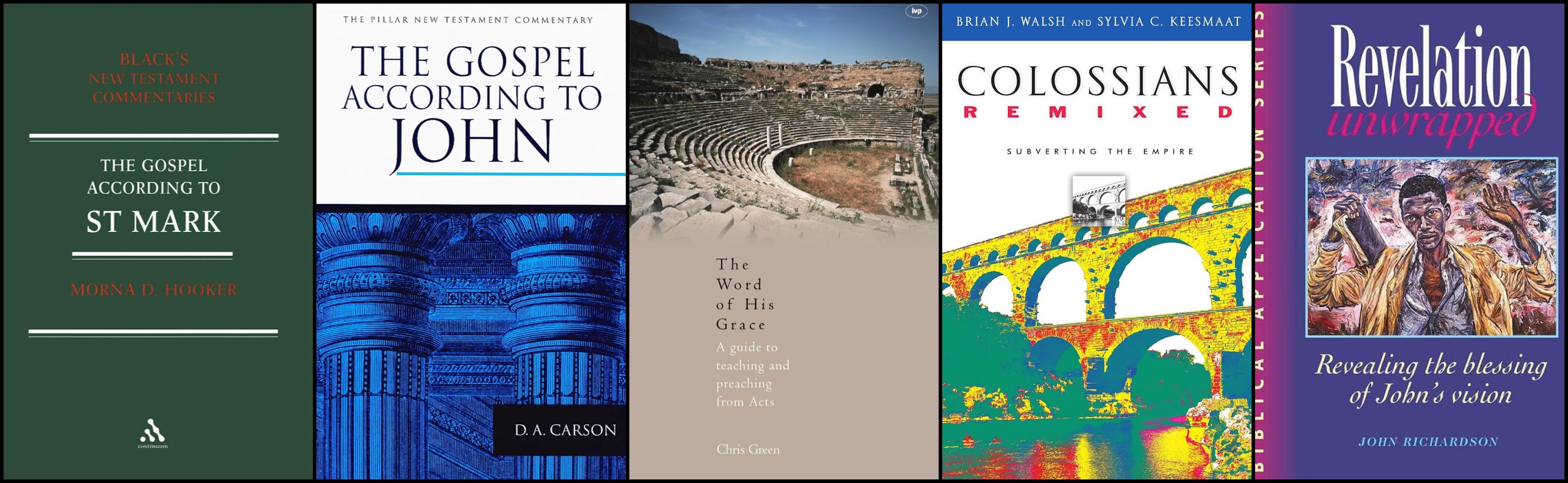
The Gospel acc. to St Mark (Black’s series) by Morna D. Hooker: Hooker was Lady Margaret’s Professor of Divinity at Cambridge (previous holders include Erasmus, Lightfoot, and CFD Moule). What makes this commentary so compelling is that she simply takes Mark’s gospel as is and lets it speaks for itself. Why would you ever not want that?
-
The Gospel acc. to John (Pillar series) by D. A. Carson: Carson displays deep textual scholarship while never losing canonical foundations (a little like Childs on Exodus, appropriately enough). This has always been a favourite, and it reliably surprises whenever I return to it. So good.
-
The Word of his Grace (teaching & preaching Acts) by Chris Green: Chris is another friend and his book on Acts is not as celebrated as I think it deserves. He takes the narrative of Luke’s tightly focused account of the early church seriously. I found it thrilling to rediscover a book I thought I knew well.
-
Colossians Remixed: Subverting the Empire by Brian Walsh & Sylvia Keesmaat: this book by a husband-and-wife team is a bit left-field and sadly too radical for some. It certainly shakes things up, and includes various fictional elements (!), imagining how different characters engage with the revolution proclaimed by Paul. Most gripping was imagining Nympha (mentioned in Col 4) and how she might have thought about Roman imperialism after conversion. This is utterly fascinating and (for me at any rate) helpful.
-
Revelation Unwrapped: Revealing the blessing of John’s Vision by John Richardson: perhaps because it is only 86pp and a slim booklet, this little gem by the late John Richardson is often overlooked. But reading this was the first time the Apocalypse became accessible to me. Despite reading and appreciating far bigger tomes, I still find myself coming back to his core ideas.
5 Books: Behind the Bible
-
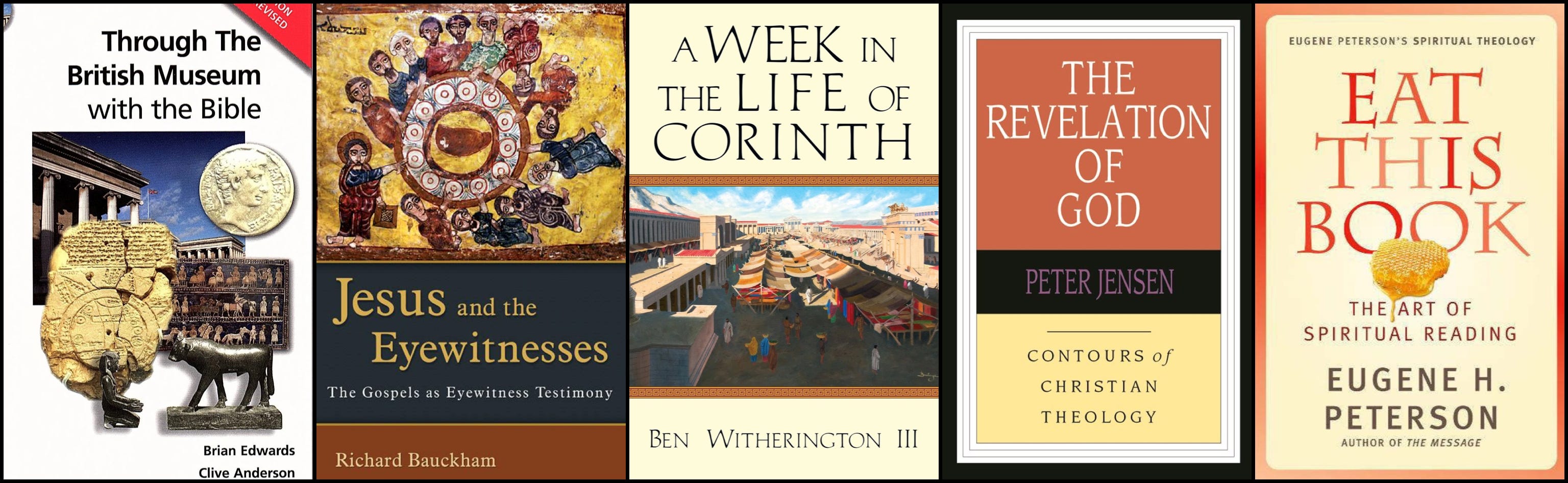
Though the British Museum with the Bible by Brian Edwards and Clive Anderson: I’ve been on, and led, BM tours and this book is such a gift. But even if visiting London is an impossible dream, this is an excellent book. Fully illustrated and yet concise, it’s remarkable how much ground it covers. For many it provides the first encounter with tangible and incontrovertible evidence of biblical historicity.
-
Jesus and the Eyewitnesses by Richard Bauckham: This has become a classic and is truly eye-opening scholarship. It is weighty and ground-breaking. For many, the biggest surprise was his ingenious analysis of Name statistics, proving the impossibility of fictitious accounts displaying exactly the correct frequency of names as 1stC Palestinian Jews and not Diaspora Jews.
-
The Revelation of God by Peter Jensen: a systematic treatment of the concept as well as outworking of the idea of divine revelation. Jensen (former Archbishop of Sydney and systematician, not to be confused with his brother Phillip!) provided countless lightbulb moments for me. Very readable too (as I’m not one who happily sits down to read systematics for fun of an afternoon!).
-
A Week in the Life of Corinth by Ben Witherington III: Another stab at fiction, this time by a classical and NT scholar. With his wealth of knowledge, he reconstructs the time Paul spent in Corinth around the time of his trial. It’s not going to go down in the annals of great literature but it never sought to! Instead it brilliantly brings time and place to life by joining many dots of scholarship.
-
Eat This book: The Art of Spiritual Reading by Eugene H. Peterson: Peterson is still much missed, a voice of spiritual sanity in a bonkers ear. Will never forget being at a U2 gig in London the night he died, and Bono paid a glorious tribute to him as he introduced the final song. This is a book of tried and tested spirituality from someone whose blood, like Bunyan, could be described as bibline. Soul-food.
5 Books: Interpreting the Bible
-
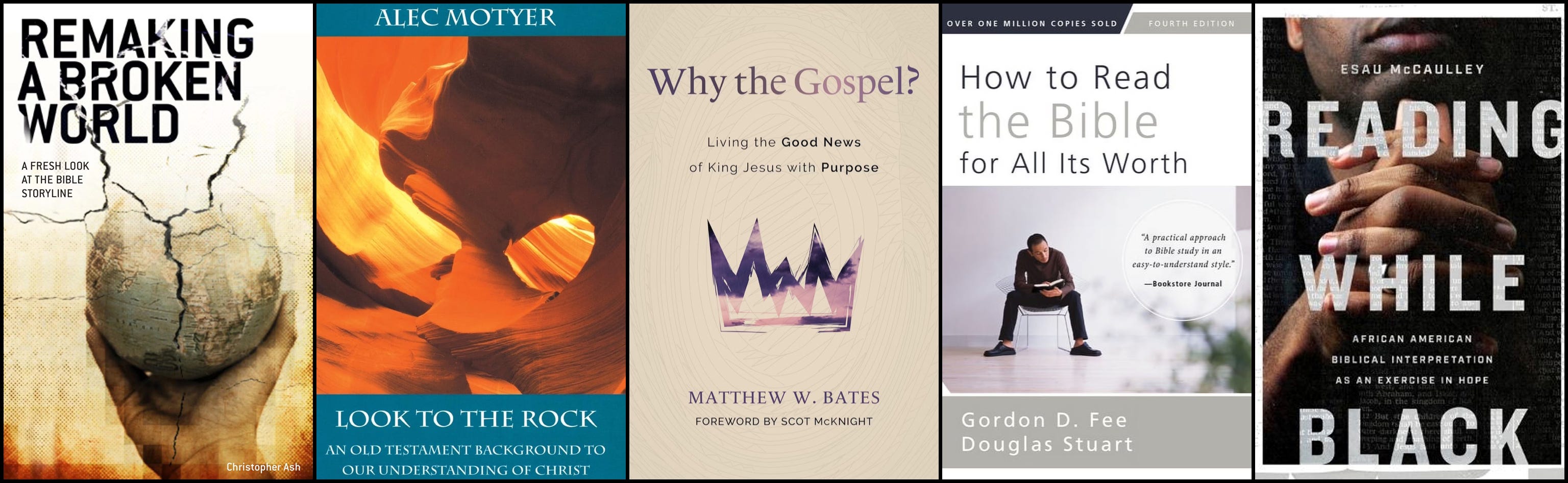
Remaking a Broken World (a fresh look at the Bible Storyline) by Christopher Ash: I used to devour the Graeme Goldsworthy treatments of the biblical narrative arc (Gospel & Kingdom onwards). And they were great. But some had a tendency to treat them as the exclusive storyline which was patently absurd. Christopher Ash’s additional (not displacing) line is breathtakingly good while simple. So compelling.
-
Look to the Rock (OT Background to Christ) by Alec Motyer: Uncle Alec’s second entry here – this is dense but so helpful, taking a handful of key OT foundations for NT Christology. It’s therefore one of those core books that people should get to at some point. It reminds us that doctrine should be truly heart-warming.
-
Why the Gospel (Living the Good News of King Jesus) by Matthew W. Bates: I was sent this to read for review and was knocked sideways. Such a simple but crucial premise: not what but why is the gospel? Why is the kingship of Jesus central and what in fact does that mean? Seems obvious perhaps. But not when you look at the life of many (most?) churches…
-
How to Read the Bible for all its Worth by Gordon D Fee & Douglas Stuart: A modern classic already in its 4th edition (or more). In essence, Fee and Stuart ask us simply to read. But because that is a skill that seems to be falling into neglect in all spheres, this is necessary and helpful. Perhaps we need to rediscover Tyndale’s vision for the ploughboy? If it could be done then, it can be done again.
-
Reading While Black by Esau McCaulley: the injustice of different demographics having repeatedly faced silencing is real and not some PC distraction. Why would one want to read only those who are like us, anyway? McCaulley gives such a helpful overview of the history of African American engagement with scripture and shows what gives him hope to persevere. Inspiring.
5 Books: Engaging with the Bible
-
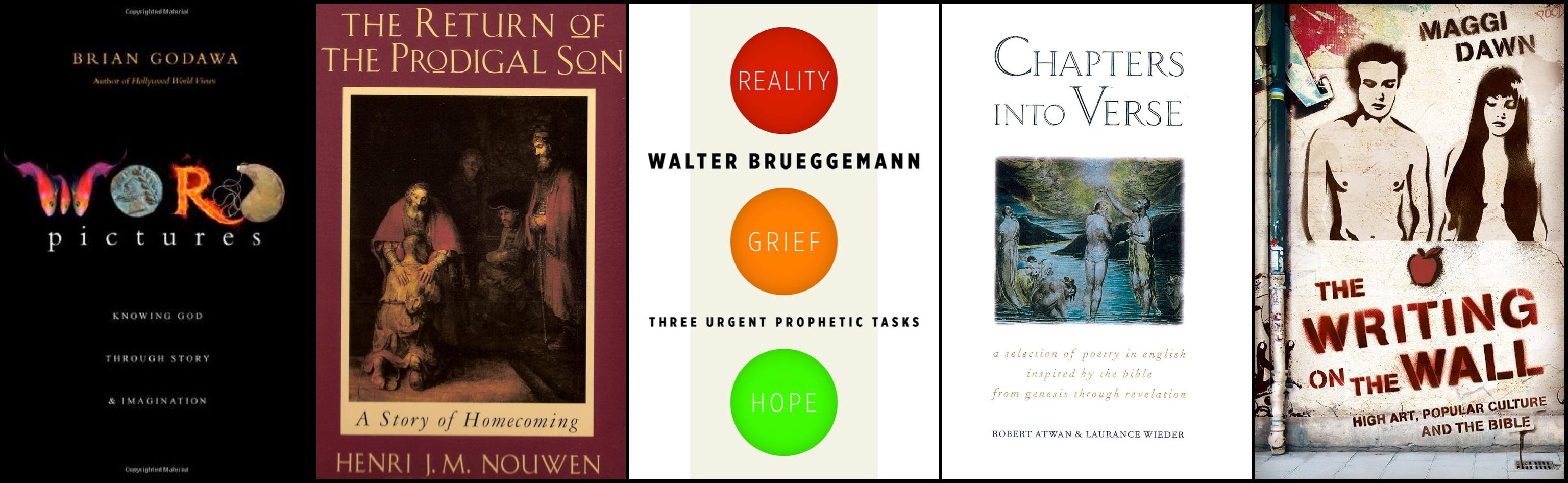
Word Pictures (Knowing God through Story & Imagination) by Brian Godawa: This is hard to track down these days (and Godawa is focused on writing odd bible-adjacent fantasies now as far as I can tell!) but it was such a breath of fresh air. A crucial reminder of how much artistry, imagination and creativity is both contained within the bible and required of its readers.
-
The Return of the Prodigal Son by Henri J. M. Nouwen: Nouwen’s book uniquely engages scripture and the arts, in particular exploring Jesus’ famous parable as interpreted by Rembrandt’s masterpiece (in the Hermitage). Very affecting and inspiring.
-
Reality, Grief, Hope (Three Urgent Prophetic Tasks) by Walter Brueggemann: An OT scholar of great note — I did find his books on psalms so helpful—this is still an urgent book, perhaps more than ever since his recent death. Is there anything left that can/should be said into this chaotic world? Too often, the church lives in unreality, fails to lament, and offers false or weak hope. Ouch.
-
Chapters into Verse by Robert Atwan & Laurance Wieder: the bible has inspired poets since it first emerged. This does not mean that the poems anthologised here necessarily provide commentary nor relate to different texts directly. Sometimes the connection is oblique. But it is always interesting to see what the two editors include. There is gold within.
-
The Writing on the Wall by Maggi Dawn: many moons ago, I was at the same seminary as Maggi – I loved this book when it came out and still return to it from time to time. A simple premise: in what ways did the bible shape English language and culture. Great stuff.