It is always a joy to return to Ukraine. Here for the second time this year, but sadly, confined to Lviv as things have become too unpredictable and complicated in Kyiv since the progressive escalation of Russian attacks. Please may it end soon. But end with genuine peace, true justice, and real reparation.
While here, I’ve spent a day based with UBTS (the Lviv baptist seminary) doing various things, including a Pastors’ breakfast for local leaders. I got chatting to a lovely bloke, Tymofii, before it got going and heard a bit of his story. Since the full-scale invasion he and his family had been refugees twice – since they come from the east, close to the 2 regions that have been occupied by Russia. They moved a few districts westwards initially, but then as the occupation took hold, they had to move again; this time to Lviv in the far west of the country. But then he suddenly said he had a present for me. I was taken aback since we’d never met. However, it was a good punt because it had been announced that I was also giving a lecture on CS Lewis’s Learning in Wartime (his 1939 sermon included in The Weight of Glory). This is material I’d given in Kyiv about 18 months which then led to a CT article. So the gift was not a complete bolt from the blue. But still…
It was a copy (he said he already had another one) of CS Lewis’s THE LION, THE WITCH, AND THE WARDROBE in Russian, from its original Soviet edition, published in Leningrad in 1975. WOW!
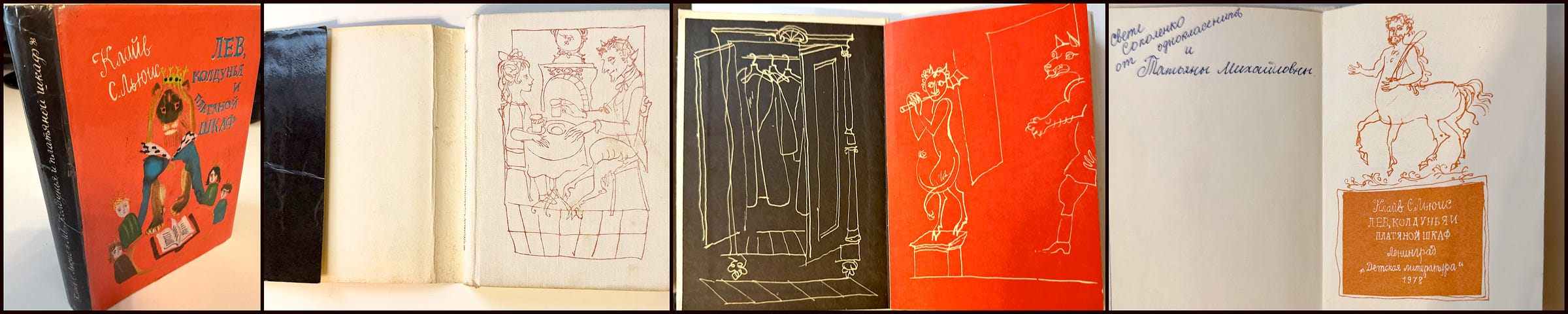
Some Classic 1970s Illustrations
Leafing through, I rather love the slightly wild palette of bright oranges and blues (which I couldn’t really capture with just my phone), as well as the jolly monochrome drawings which are so immediately identifiable.
It was translated by one G. Ostrovskaya (of whom I can discover nothing), but I was intrigued by the illustrator: G. A. V. Traugot (of whom I’ve had some success here and also here). It seems there was quite a community of remarkable book illustrators in Leningrad from the 1930s onwards.
G.A.V. is the collective initial of the Russian artistic trio: Georgy Traugot (1903-1961) and his two sons Alexandr (born 1931) and Valery (1936-2009). Traugots have illustrated more than 200 books since 1950’s and are amongst most celebrated Russian artists. Having survived World War II and the siege of Leningrad, Alexandr Traugot now lives in Paris and is still actively engaged in art making and illustrating. His work is highly sought after by collectors and publishers.
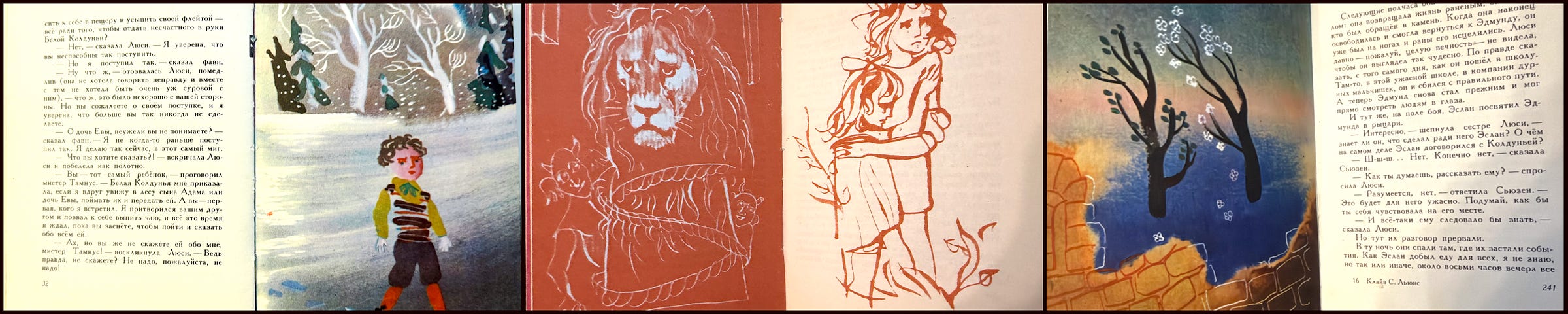
That, in itself, is interesting. But what was truly fascinating was the preface, presumably by the translator or perhaps a publishing house higher-up. (Incidentally, not being a Russian speaker, I can’t easily search to figure out whether the publisher’s name is Detskaya Literatura or it’s merely describing the genre—it literally means children’s literature.)
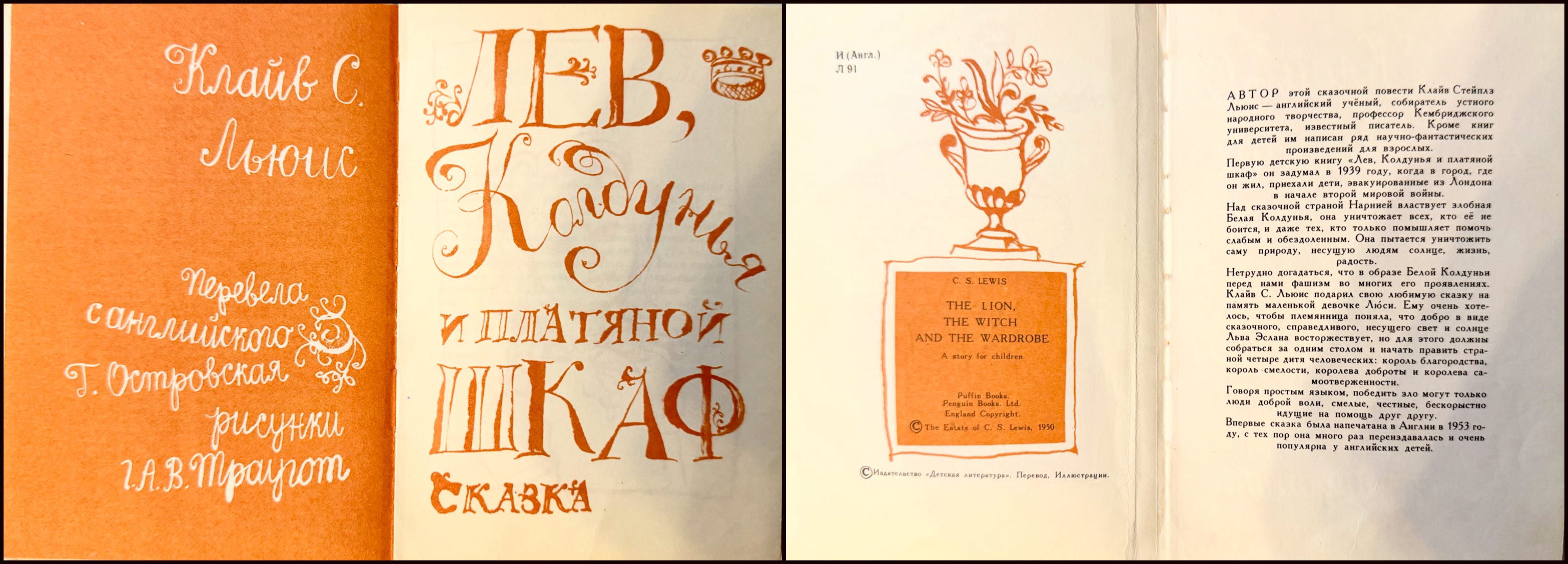
An Almost Laughable Modernist Agenda
This is the google translate take on this preface (above right):
THE LION, THE WITCH AND THE WARDROBE: A FAIRY TALE
The author of this fairy-tale narrative, Clive Staples Lewis, was an English scholar, a collector of folklore, a professor at the University of Cambridge, and a renowned writer. In addition to his books for children, he also authored a number of science fiction works for adults.
He conceived his first children’s book, *The Lion, the Witch and the Wardrobe*, in 1939, when children evacuated from London at the beginning of the Second World War arrived in the town where he lived.
The magical land of Narnia is ruled by the malevolent White Witch, who destroys anyone who does not fear her—even those who merely contemplate helping the weak and the downtrodden. She seeks to annihilate nature itself, which brings sunlight, life, and joy to the world.
It is not difficult to discern that the White Witch represents fascism in many of its manifestations.
Clive S. Lewis dedicated this beloved tale to a little girl named Lucy. He deeply wished for his young relative to understand that goodness—embodied by the noble, light-bringing, and sun-drenched Lion, Aslan—would ultimately triumph. Yet, for this to happen, four human children must come together to rule the land: a king of nobility, a king of courage, a queen of kindness, and a queen of selflessness. (!!)
In simpler terms, evil can only be defeated by people of good will—those who are brave, honest, and willing to help one another selflessly.
The story was first published in England in 1953; since then, it has been reprinted many times and remains highly popular among English children.
I’ve highlighted several bits that really stood out. It really is a little window into its time: the Soviet Union mid-1970s, very much the tail-end of the Brezhnev era, epitomising the gerontocratic decline of the system. And yet, the fall of the Berlin Wall would have seemed inconceivable at this point. Communism was here to stay… So look what the preface says:
-
‘not difficult to discern…’: white witch = fascism!! Oh I see… OK, then. And fascists hate those who help the weak and the downtrodden (which is indeeda fair point).
-
how does evil (aka ‘fascism’) get defeated? ONLY by people of good will and selflessness… (ie good, selfless servants of the people, then)!
But look what’s missing!
-
Lewis has written a ‘fairy-tale’, the first of several. But from what Tym told me, and after a quick search, the publishers never followed this with the Narnia books. More significantly, we’re only told he wrote science-fiction (an excellent Soviet genre). No mention of any of his scholarly work, nor inevitably of his prolific theological and apologetic writing. That would never do in the USSR.
-
The White Witch’s evil is described in exclusively elemental terms—seasons, nature, the sun, joy, life— and by inference that means Aslan because he was light-bringing and sun-drenched. But there is nothing metaphysical or transcendent about Aslan here. For it would never do to raise one’s head beyond the closed universe since that’s simply not possible. So that would never do in the USSR either.
-
How does one defeat her? Well simple – have integrity and purity and band together. Not a hint of the 4 children’s flaws and weaknesses that result in them refusing to believe poor Lucy after she first goes through the wardrobe, getting picked off via Turkish Delight, and generally falling out. Even more significantly, not a hint of anything sacrificial and miraculous in Aslan himself, nor the fact that it is only through him that the witch can be defeated (not the Pevensies’ selfless solidarity!). And that would absolutely never ever do in the USSR.
Just amazing. For sure, it’s a very brief introduction to the book, and it’s not intended to be a full précis. But that makes it all the more interesting to see what the writer does decide to include. Evidently, the bosses decided that this was a great story and thus worthy of translating. By avoiding mentioning the bigger picture of Lewis’s purpose, worldview and passions, they hope that such things will remain obscure.
And this is how it was for some…
After my lecture this evening, I had some fascinating conversations with folks. One with a couple perhaps in their late 40s was astonishing. The husband had asked a question in the session about George Macdonald’s Lilith (of all things) and its relationship to Lewis and the Inklings. Well that was unexpected in itself! But both of them adored Macdonald’s writing in all his weirdness because (in the wife’s words) they contained ‘so much pain and love.’ And then they brought up Narnia.
They had both loved the books (encountering them first as adults), but had never fully grasped what they were all about at a deeper level despite being Christian believers for some years.. It took them several read-throughs for the penny slowly to drop. But their son—who started them aged 10 quite recently—got it almost immediately. ‘Aslan’s JESUS isn’t he!?’
Such is the power of stories to grip, perplex and inspire. And sometimes bring to faith. So who knows how many across the vast sweep of the Soviet empire can look back on the first seeds of Christian faith being sown by this extraordinary translation? To that end, I rather love the suggestive inscription in biro on the inside front endpaper:
from Sveta Sokolenko’s classmates and from Tatyana Mikhailovna.
What a gift.