
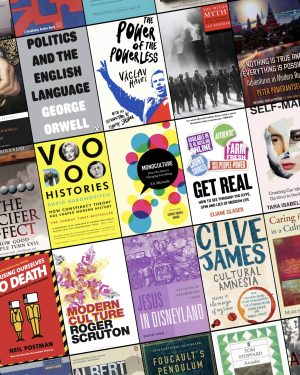
Few would disagree that the world in 2026 is undergoing a process of extraordinary transition. This is not unprecedented. It happens every few decades or perhaps century. But trying to understand what is to come depends on understanding where we’ve come from, what is being challenged and what is emerging.
I’m neither historian, sociologist nor philosopher. So I feel particularly out of my depth. This is a list of books that have struck me between the eyeballs. It is not exhaustive and experts will identify the big gaps.
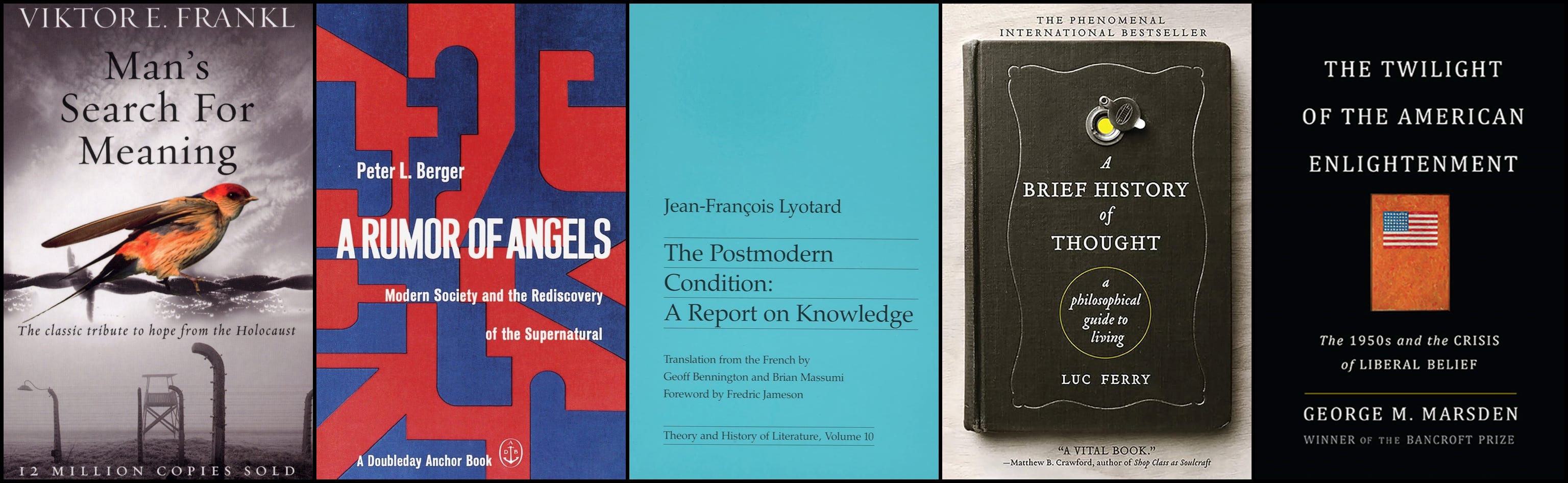
5 Books: Immersed in Big Ideas
-
Man’s Search for Meaning (1946) by Viktor E. Frankl: let’s start with the most important. Such a crucial but breathtaking book, and like the works of Primo Levi, it is a serious meditation on what is possible after the ovens of the Holocaust. His perceptions on who in the camps survived forces us to put ourselves in their shoes.
-
A Rumor of Angels (1970) by Peter L. Berger: Berger was the first to help me realise that the scientific materialists who appeared to hold sway over the 20th Century might not as watertight as they seemed. This book burst through the canopy of the closed universe and felt like such a relief!
-
The Postmodern Condition: A Report on Knowledge (1984) by Jean-François Lyotard: Probably the densest and heaviest book of the whole list but Lyotard helped me begin to grasp the tectonic shifts in thinking, explaining why people are so suspicious of the grand stories (or metanarratives as the posh bods call them).
-
A Brief History of Thought: A Philosophical Guide to Living (2011) by Luc Ferry: a philosopher and former Minister of Education in the French Government, this is a brilliantly accessible overview. The most surprising aspects are, firstly, his inclusion of Christianity as a philosophical step (while explicitly accepting that it is not a philosophy per se) and secondly, his recognition that it is the most attractive proposition despite his atheistic conviction that it is false. Fascinating.
-
The Twilight of the American Enlightenment (2014) by George M. Marsden: A random inclusion perhaps, but it is one of the most compelling works of cultural history I’ve read. His contention is that the USA (and West generally) really changed in the 1950s and NOT the 1960s (as everyone assumes). His explanations are startling but utterly compelling. Eye-popping.
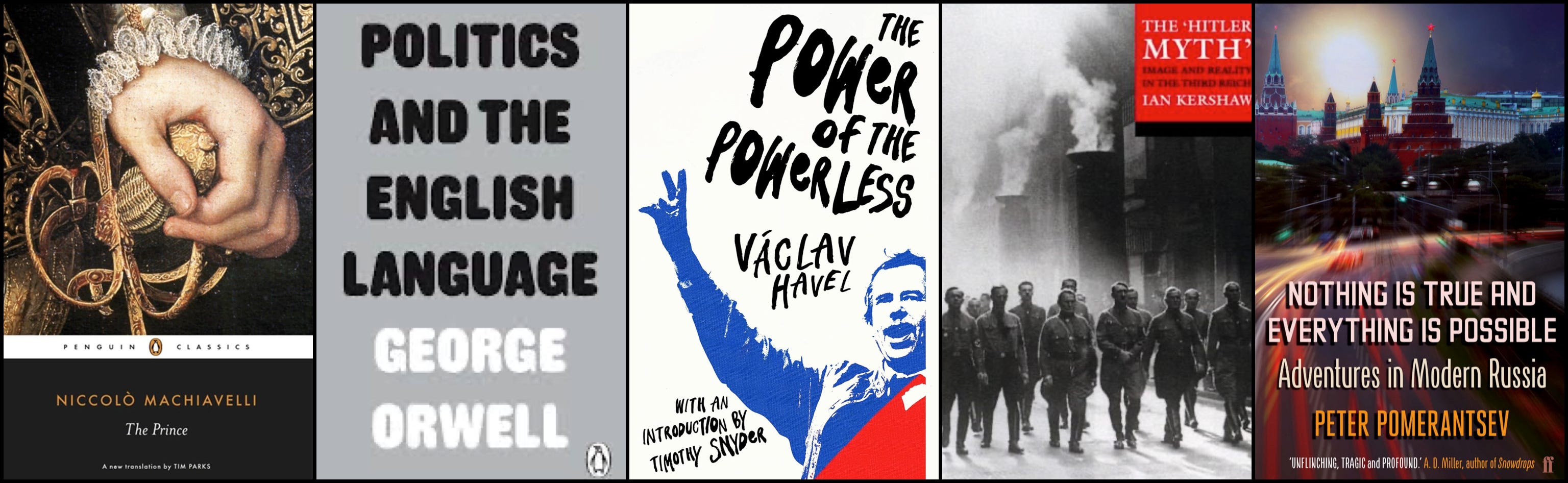
5 Books: Why do they vote them in?!
-
The Prince (1532) by Niccolò Machiavelli: The oldest on the list. Controversial but brilliant: a distillation of how to wield raw power, Machiavelli provides a chilling grid for assessing the realpolitik challenges of sustaining a grip on power.
-
Politics and the English Language (1946) by George Orwell: One of the great essays of the last century. A short read, this, but one I find myself returning to frequently. It is a great first stop in trying to parse politicians’ speech. Watch out for clichéd metaphors and unnecessary complexity.
-
The Power of the Powerless (1978) by Václav Havel: Nobody had a clue at the time he would become Czechoslovakia’s first post-Communist President – the playwright wrote this essay at great cost, but it is a brilliant assessment of the capacity of people to operate in a totalitarian state (despite what the authorities let them believe). Inspiring.
-
The Hitler Myth (2001) by Ian Kershaw: I’ve written about this book here before. Kershaw is a renowned historian of Nazi Germany, having written a mammoth 2-volume Hitler biography. Here he compares what people believed about Hitler with what was actually true – and the chasm is breathtaking. Stunning evidence for the effectiveness of propaganda. Be warned.
-
Nothing is True & Everything is Possible: Adventures in Modern Russia (2014) by Peter Pomerantsev: Taking the propaganda point forward, this brings things right up to date with an insider view of how Television makes controlling a country of 11 time zones(!) possible. A brilliant book.
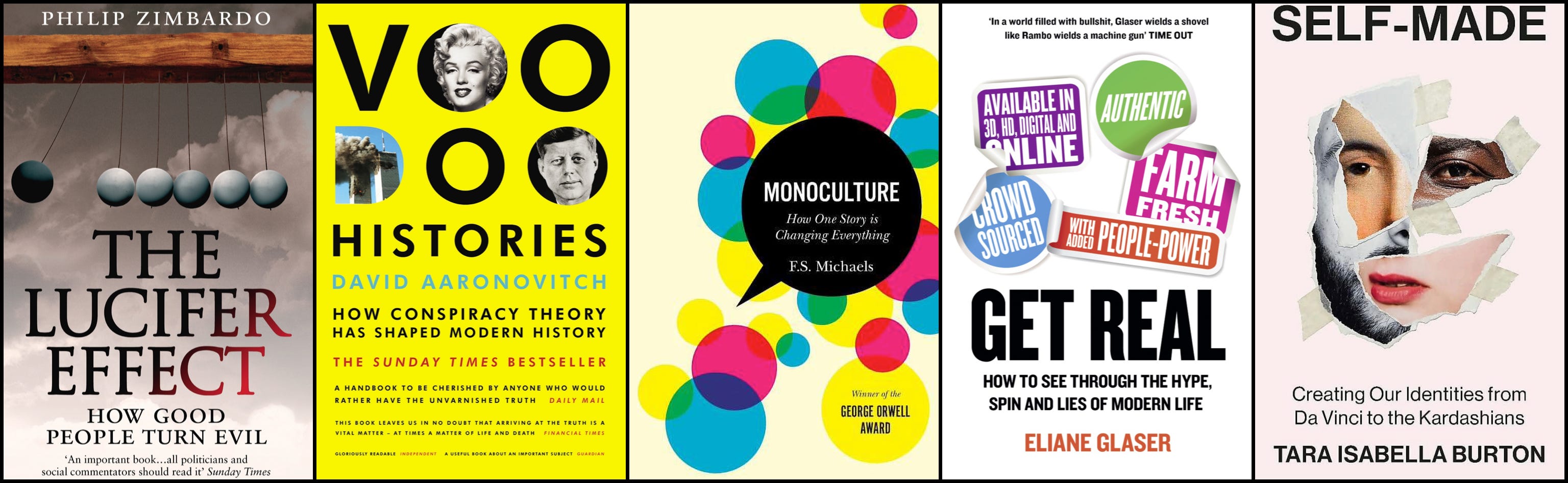
5 Books: The Social Effects
-
The Lucifer Effect: How Good People Turn Evil (2007) by Philip Zimbardo: Zimbardo is infamous for the notorious Stanford Prison Experiment. When the atrocities of Iraq’s Abu Ghraib prison were exposed, Zimbardo felt compelled to revisit the dark chapter of his Stanford research because he saw grim parallels. An important if controversial insight into how social pressure affects people.
-
Voodoo Histories: How Conspiracy Theory Shaped Modern History (2010) by David Aaronovitch: one of my favourite books of the last 20 years. Aaronovitch goes through the 20 big conspiracy theories of the time and tries to draw threads and pathologies. More than any other, this made me even less of a conspiracist than I was.
-
Monoculture: How One Story is Changing Everything (2011) by F. S. Michaels: Not sure why I picked this up – but it made so much sense of our society. And the monoculture she exposes? Economics. It’s hard to refute that judgments, moral dilemmas and government policy decisions tend to be reduced almost exclusively to the economic. Once seen, hard to miss.
-
Get Real: How to Tell It Like It is in a World of Illusions (2013) by Eliane Glaser: Glaser is a literature scholar, radio producer and writer and even though things have developed almost unrecognisably in the last 13 years, this is still a very useful foundation for getting a purchase on solidity.
-
Self-Made: Creating our Identities from Da Vinci to the Kardashians (2023) by Tara Isabella Burton: A stunning read, I was torn between this and Burton’s earlier book, Strange Rites. It’s so good to read stuff by people who can make unexpected connections to point to bigger stories.
5 Books: The Air We Breathe
-
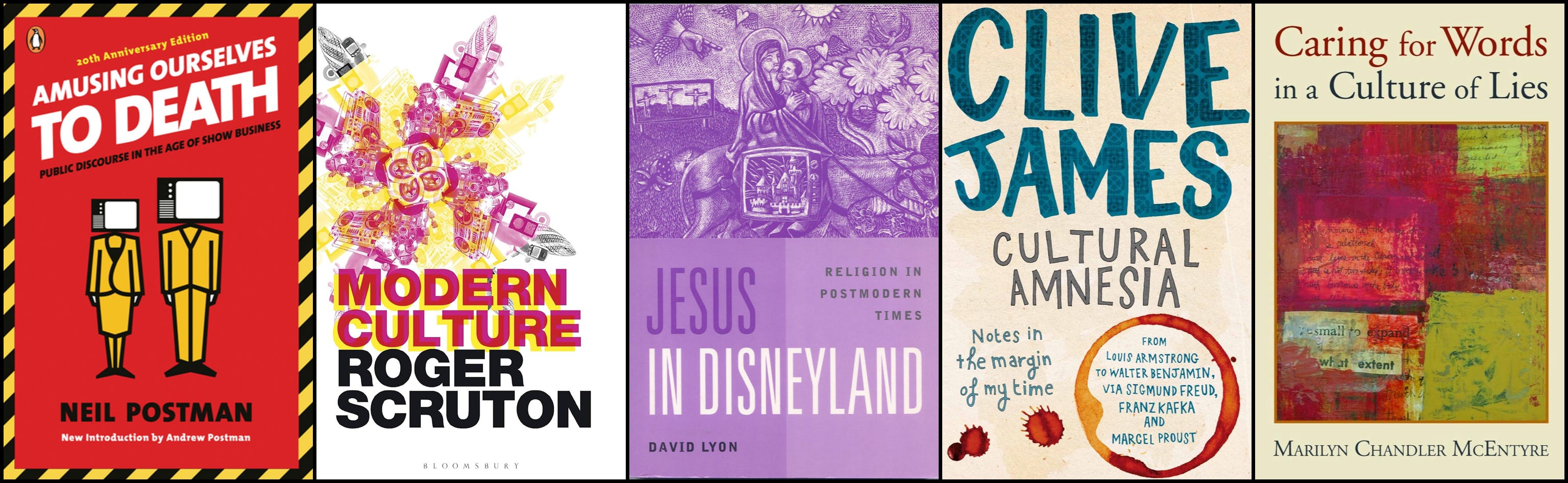
Amusing Ourselves To Death (1985) by Neil Postman: A classic analysis of the impact on television on all areas of modern life from politics to religion. Some have challenged his negativity, but to read him 40 years on is to recognise how prescient he was. Remarkable.
-
Modern Culture (2000) by Roger Scruton: the late Sir Roger was fairly iconic as a scourge of woolly thinking especially on the left. In this book he makes an impassioned appeal for so-called high art in the face of dumbing down to lowest common denominator pulp. A great advocate for having to work at art, because accessibility really shouldn’t be the only criterion for what works. Polemical and stimulating.
-
Jesus in Disneyland: Religion in Postmodern Times (2000) by David Lyon: David Lyon is a British sociologist who has worked and taught in Canada for years, and is a superb guide to the cultural shifts we are facing. I didn’t understand it all, but think I grasped enough to see what he’s on about. It is hard not to recognise so much of what he identified 26 years ago as becoming mainstream in today’s streaming world. And he is much more sympathetic to a premodern worldview than one might expect in such a book…
-
Cultural Amnesia: Notes in the Margin of My Time (2007) by Clive James: the late great Clive James was a polymath and yet also hilarious. An accomplished poet, a brilliant TV host, memoirist and commentator. This is a book to dip into – a collection of 100+ essays which engage with pretty much anything. He’s as good in providing entrées into classic works of art as he is in the bon mot and passing comment. Brilliant.
-
Caring for Words in a Culture of Lies (2nd ed, 2021) by Marilyn Chandler McEntyre: I picked this up on spec, knowing nothing about Chandler McEntyre but loved this book. She’s a poet and poets love words by definition: their hallmark is precision and forethought. Loved this book.
5 Books: Stories To Inhabit the Vortex
-
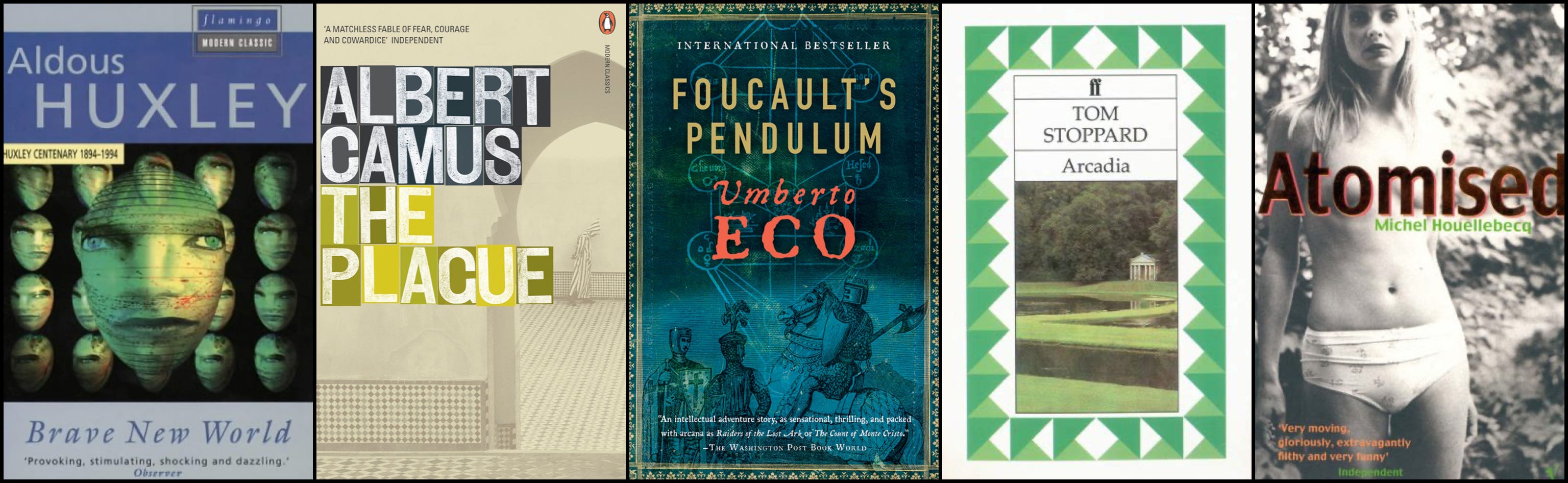
Brave New World (1932) by Aldous Huxley: Neil Postman famously asked if Orwell’s 1984 or Huxley’s was the more likely dystopia. In a media-saturated society it’s hard to deny that Huxley was onto something. A brilliant novel.
-
The Plague (1947) by Albert Camus: He’s perhaps more famous for L’Étranger (The Outsider) but this novel is even greater. Camus is easily my favourite of the mid-century French existentialists. He seemed to have a deep intellectual integrity. This is a stunning story about an Algerian town dealing with a deadly outbreak that provokes its quarantine. The various responses to the predicament are telling, challenging and provocative. A masterpiece.
-
Foucault’s Pendulum (2001) by Umberto Eco: The great novel about some scholars who decide to create a fake conspiracy theories but then scramble to figure what to do when it gets believed and spreads. But that’s just the surface of this riveting and fiendishly plotted book. But couldn’t help but be reminded of it when reading Phil Tinline’s recent, scary history The Ghosts of Iron Mountain.
-
Arcadia (1993) by Tom Stoppard: My favourite play written in my lifetime and perhaps of all plays. It’s not too ‘clever-clever’ as some accuse Stoppard of being – it’s just sparklingly inventive and emotionally compelling. A play about ideas that moves as much as it stimulates. What do we really know about anything, in the end?
-
Atomised (2001) by Michel Houellebecq: this is NOT for the faint-hearted and I’m slightly reluctant to include this. Houellebecq’s subject matter and obsessions are pretty stomach-turning. But he’s nothing if unafraid to tackle taboos in an almost prophetic way. Set in his native France, he pushes reality to what it really is in a godless, lawless, lost world. The allure of the 60s’ sexual and political freedom has last all its sheen by the time you work out its consequences. And Houellebecq is rigorous in doing just that.
So there it is. As I said, it is not exhaustive, nor even a list of all the best in their fields. But these books stick in my mind as those that have most affected me as I’ve tried to navigate it all. What might you add/subtract?