-
Is human suffering a zero-sum game?
-
Is it a competitive sport? Does one person’s pain render them more worthy of a platform than another’s?
-
Can one person’s suffering justify revenge when another’s identical desire is judged illegitimate?
-
Where, and how, does this all end?
Two Potential Enemies
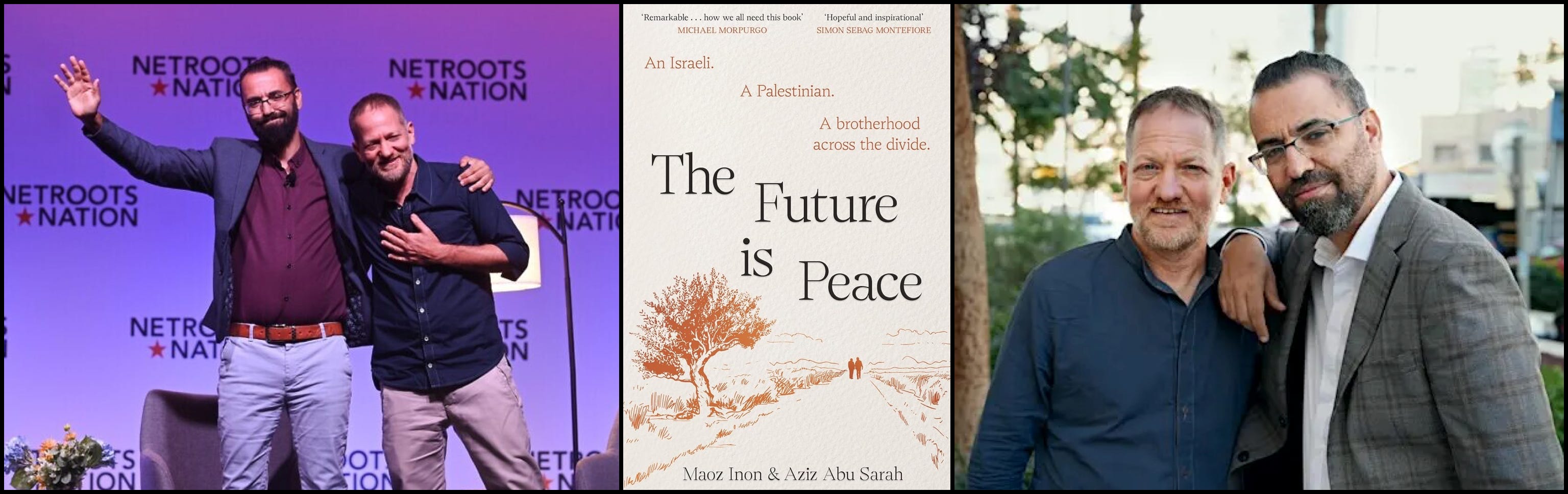
In theory, these questions have straightforward answers. Of course not. And yet that is simply naive in the real world of competing narratives, ideologies and credentials. But just when the current conflicts in the world seemed impossible to quell, The Future Is Peace, a book by a Muslim Palestinian and Jewish Israeli, has left me speechless. Because these do seem necessary sadly, here are their credentials in suffering:
-
Maoz Inon is the grandson of Jewish immigrants during the British mandate who helped to found the secular, socialist kibbutz in which both Maoz and his father were born. However, as things turned out, this kibbutz was situated just a kilometre or two from what became the Gaza border. Both Maoz’s parents were killed on Oct 7th, as were many lifelong friends.
-
Aziz Abu Sarah is a Muslim Palestinian whose family goes back many generations. When Aziz was just 7, his older brother Tayseer (who in many ways functioned as a surrogate parent and protector) was arrested by the IDF (Israeli Defence Forces), subsequently badly beaten and tortured, and then soon after his release died of his internal injuries. For years, Aziz was gripped by rage and the desperation for revenge. Things only began to change as an 18-year old he decided to learn Hebrew (having despised the language) and experienced a simple act of kindness from his teacher, a Jewish Israeli woman.
Agreeing on terms
Both men have been involved in creating so-called Dual Narrative Tourism in the region. Despite having met only once before Oct 7, it was Aziz’s simple text message of condolence to Maoz that resulted in a profound friendship and a form of pilgrimage in the territory that became this book’s focus. I could not put it down, reading it in just a couple of days. It is profoundly affecting.
Both had to listen. Both had to learn. And remarkably, both have learned to laugh together (Aziz’s sense of humour is infectious, as is clear in the Jon Stewart conversation below) and both have learned to love. But theirs is no limp or platitudinous conflict-aversion. There can be no partnership if the disagreements or fury are muffled. Each needs the space, let alone permission, to speak as they see it and they accept that they will not always agree. When injustice occurs, whoever the perpetrator or victim, it needs calling out. That is the truth-telling on which peace-building fundamentally depends. Yet, as Aziz says (and repeats to Jon Stewart),
anger is like nuclear power; it can bring destruction or make light.
For example, if there is to be any conceivable hope for Russia-Ukraine reconciliation, there will need, at the very minimum, radical and honest truth telling, as well as the willingness to hear the grounds for victims’ anger. But that’s an aside, for now. Back to the issue in question.
They were invited to converse publicly at TED (merely days after Maoz lost his parents—please do watch the video below). Aziz writes:
Before our TED Talk, Maoz had said to me, When we tell our stories, let’s make sure we use the same words. If you say your brother was murdered, I’ll say my parents were murdered. If you say killed, I’ll say killed. There is power in our personal narratives, and Maoz understood that there should be equality even in the language we use to tell our stories. We both understand that true equality isn’t possible now, as the reality around us makes it unattainable. But acknowledging this, and working to change it, is essential tor genuine peacemaking. (p46)
The Land of Dual Narratives
If one debate gets to the heart of where the disagreements lie—the two extremes of the spectrum—it is of course the meaning of 1948 and what gets summarised here by Maoz (note his readiness to also quote a Palestinian perspective without qualification, an agreed principle by both writers throughout the book):
Palestinians see Zionism as a destructive force; the Palestinian author and literary critic Edward Said described it as, an uncompromisingly exclusionary, discriminatory, colonialist praxis.” But for many Jews, including my grandparents, Zionism was originally about saving lives. As former Israeli prime minister Golda Meir once said, “There is no Zionism except the rescue of Jews.” (p50)
-
For Jews, 1948 meant a grasp at existential survival post-Holocaust. They flocked from all over the world to what was (in the Zionist narrative) a ‘a land with no people, for a people without a land’ (p16). It felt like the last chance saloon after 6 million had been murdered.
-
For Palestinians, 1948 meant the nakba (the catastrophe). A year later, more than 80% of those who had lived within the newly-formed borders of the State of Israel had gone: they’d fled to refugee camps or to cities or had lost lives. Countless homes and settlements were razed. That left 150,000. They were given citizenship but under tough restrictions; there are now roughly 2 million Palestinian Israeli citizens: so still 20%.
One of the most moving moments in the book comes from Aziz’ father’s first experience of a peace meeting that his son is hosting. I won’t spoil it here because he tells the story so well in both videos clipped. But the profound awkwardness of the moment leads to a breakthrough in all kinds of ways for people on both sides.
It does prompt the recognition of an undergirding fear that many must face when getting involved in such work. Might acknowledging another’s pain marginalise, or perhaps even invalidate, my own? Here is Aziz remembering how hard it was for him pluck up the courage to visit the Yad Yashem (the Holocaust museum in Jerusalem) because, for example, the 1948 Deir Yassin massacre was not memorialised.
There is no memorial to commemorate Deir Yassin, no Museum of the Nakba in Israel for the Palestinians who were murdered in 1948. Palestinians are denied the privilege of publicly memorializing our own traumatic history. For a moment, I considered turning around and going home. A part of me feared that if I empathized with the “enemy,” it would be a betrayal of my own pain.
…
Many Palestinians fear that acknowledging the horror of the Holocaust is tantamount to excusing the Nakba and the occupation of our land. They have a fear of acknowledging any Jewish pain at all, regardless of whether it was caused by Nazis or by Palestinians. It’s the same for Jewish Israelis who don’t know the history of the Nakba. They fear that if they acknowledge Palestinians’ suffering, it will absolve Hamas of its horrific deeds. But this mindset keeps us trapped in endless violence. How will we ever learn how the other side thinks and feels if we do not try to understand each other’s painful histories? (p200)
I am astonished by that paragraph. I cannot even begin to imagine how hard it must be to have written it, quite apart from how much antagonism and incomprehension it must generate from either side. But that is what this book is like throughout.
Needless to say, this is a must-read. We all know about a world where victims are driven to become perpetrators and thus create a whole set of new victims. Ad infinitum. But how different the world would be, could be, should be, if we all had the courage to learn from Aziz & Maoz.
I’ll close with two (of the several) poems quoted in the book. Intriguingly, both are Irishmen, one from the north, one south. Stop was explicitly provoked by the 2014 war in Gaza:” ‘with the staccato-like urgency of a telegram, Gorman imagines a bereaved Palestinian parent speaking to an Israeli.’ (p68) The other reflects on the effects of Ireland’s ‘Troubles’.