
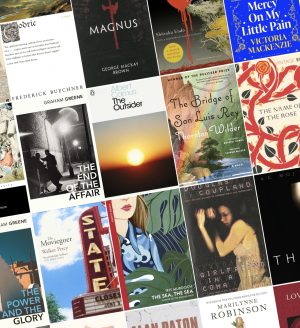
God is curiously absent from contemporary fiction. Not surprising I suppose, seeing as he’s absent from much of contemporary life. Or rather, he’s missing from the public square discourse of most bien-pensants.
That is quite the surprise when one considers the proportion of human beings, quick or dead, who have never taken issue with his existence or intervention. Perhaps some writers are shifting in their willingness to accept this as a fact of life, especially when casting imagination’s eye to a bygone era, rather than using their narratives as an excuse for back-projecting modern scepticism (thinking of C. J. Sansom’s otherwise brilliant Shardlake Tudor mysteries).
Warning! This is a personal, flawed and hardly exhaustive list. Some will note lack of Russian masters. That’s simple: I find them intimidating. Then there’s the fact that the groupings into 5 are fairly arbitrary. I also break my 1 book per author rule for this 25 (Graham Greene warrants at least 5 entries IMHO). And I can already think of about 12.6 books that should also be here. And I’ve not even mentioned Francis Spufford… Oh well. Here goes…
5 Books: Stories set in bygone ages
-
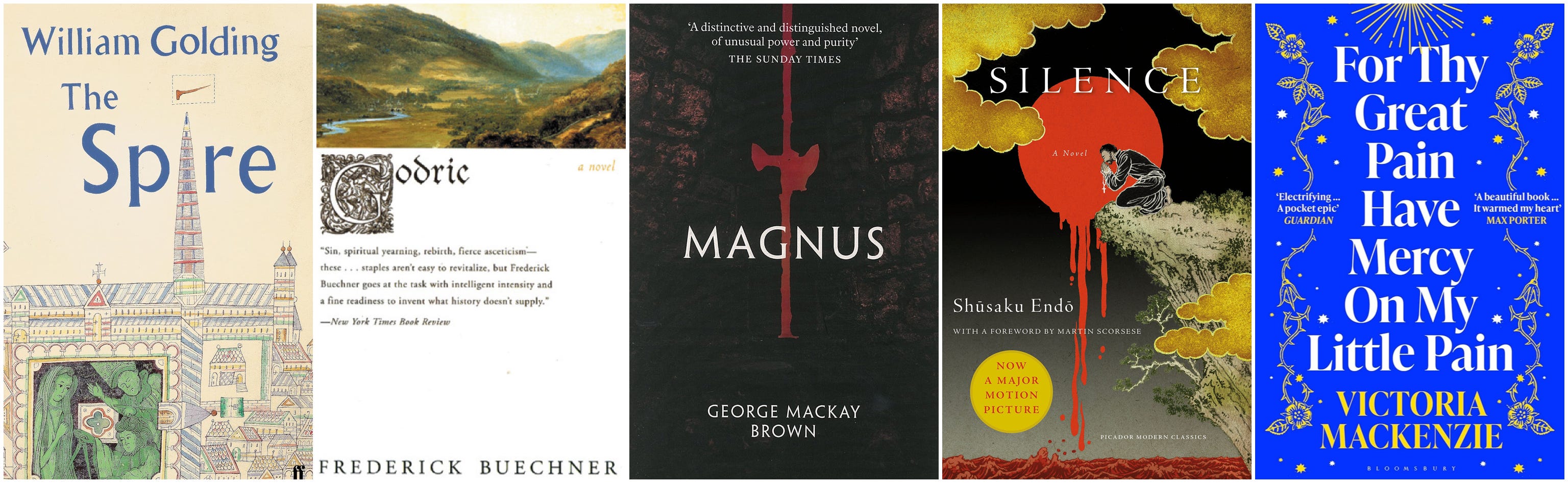
William Golding’s THE SPIRE (1964): The first of this 25’s Nobel Laureates. Golding is best known for The Lord of the Flies which is very theological too. But this account of ecclesiastical ambition and hubris during the mediaeval construction of an English cathedral is gripping.
-
Frederick Buechner’s GODRIC (1980): Nominated for the Pulitzer, and the subject of a recent Triptych, Buechner’s mediaeval hermit is vividly relatable in his crippling guilt and self-hatred, despite the outlandish extremes of his life, and, more to the point, despite the Bishop of Durham’s relentless goal of making him a saint via the hapless monk Reginald.
-
George Mackay Brown’s MAGNUS (1973): written after the Orcadian writer became a Catholic about the Orkney king, martyr and saint, Magnus Erlendsson. This is a vivid but alien world, full of perplexing and provocative imagery; not least through the entirely unexpected flash-forward towards the end to Flossenburg Prison in 1945 where Dietrich Bonhoeffer would be executed. Strange, a little bewildering, but profoundly affecting.
-
Shusako Endo’s SILENCE (1969): this is the book that perhaps prompted Endo’s soubriquet, Japan’s Graham Greene. Greene was undoubtedly a promoter of his writing, and of this book in particular. Narrating the fate of several Portuguese Jesuit missionaries to 17thC Japan, this grapples with the hardest theological questions of all: divine silence in the face of the most acute (and, indeed, maliciously inventive) suffering of his people. One of the most searing books I’ve ever read – and yet, even here, we see the glimmers of the dawn’s light. But only just… Astonishing. (Scorsese’s recent cinematic version is pretty epic, too).
-
Victoria Mackenzie’s FOR THY GREAT PAIN (2023): just picked this up randomly in a bookshop because of its quirky title. First time writer Victoria MacKenzie has written a beguiling and insightful novel about the 1413 meeting of two historical: Julian of Norwich and Margery Kempe. Both suffered greatly the incomprehension and scorn of their contemporary, very male world, but both were resolute in their convictions and vision. Beautifully imagined.
5 Books: Scepticism and Scorn for Faith
I did say the groupings were arbitrary. But because they have characters or themes that generally represent scepticism, I’ve bunged them all in here.
-
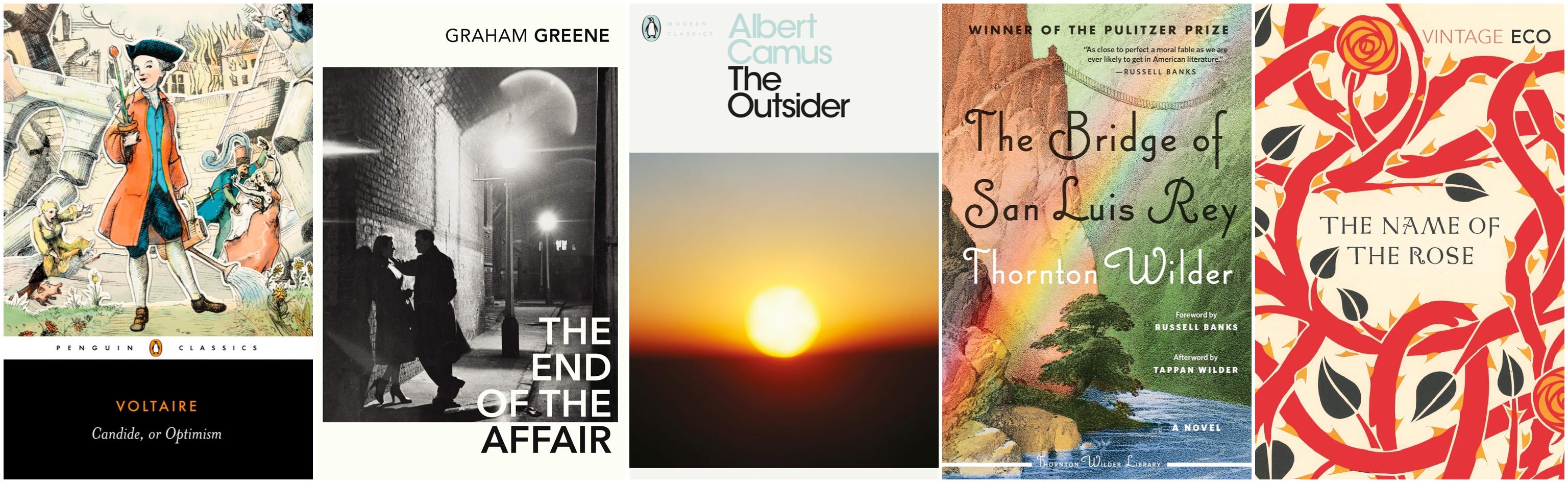
Voltaire’s CANDIDE (1759): the arch-sceptic himself, Voltaire’s Candide is a classic, dripping with an 18thC satirist’s biting scorn. I was rather bamboozled by it when it was one of my A Level French set texts, but it wormed its brilliance into me. It’s cunning and powerful; and the hypocrisy and platitudinous beliefs about suffering that he exposes are certainly worthy of his attacks. But in the end Voltaire’s reason isn’t quite as reasonable as him might have thought. But that could just be me…
-
Graham Greene’s THE END OF THE AFFAIR (1951): this is one of the greatest novels ever written in my view. I’ve come back to it several times; it is just so dazzlingly unsettling. Maurice Bendrix is nearly killed in a V1 rocket attack on his flat. Sarah, his lover, prays a brain-twister of a prayer in a desperate bargain with God – and so finds herself having to comply when it is apparently answered. The consequences are devastating, not least for Bendrix’s wellbeing. Just superb writing.
-
Albert Camus’s THE OUTSIDER (1942): no answered prayers in this one, though. Nothing in the world appears to affect the French Algerian Meursault, including the death of his mother in a retirement home. He gets embroiled in a group of fairly unsavoury characters, ends up having to defend himself against a knife-wielding relative but this results in firing a gun at him four times. After his arrest and death sentence, the prison chaplain infuriates him with his absurd religion, prompting the retort that our death renders everything meaningless anyway. Camus is at his honest best here.
-
Thornton Wilder’s THE BRIDGE OF SAN LUIS REY (1927): Suffering is also the catalyst here, as a Peruvian priest tries to find rhyme or reason why the individuals might have died when an Andean footbridge collapsed in 1714. In some ways it reflects the precisely questions put to Jesus in Luke 13. It’s not hard to see why this won the 1927 Pulitzer Prize, since it’s a spare and compelling invention. Very powerful.
-
Umberto Eco’s THE NAME OF THE ROSE (1983): I read this around the time the movie with Sean Connery and a very young Christian Slater came out. And instantly became an Eco addict. I rarely grasped what his novels were always on about, but I could never stop reading. This book is everything you could possibly want in a historical novel – setting, characters, mystery, alien obsessions and weird goings on, plus a brilliant detective monk intentionally called William of Baskerville in allusion to the master of reason Eco was inspired by. But Eco’s scepticism is on display since the truth, à l’Occam, is far more mundane than the monks dare believe.
5 Books: Capturing Doubts ’n All
-
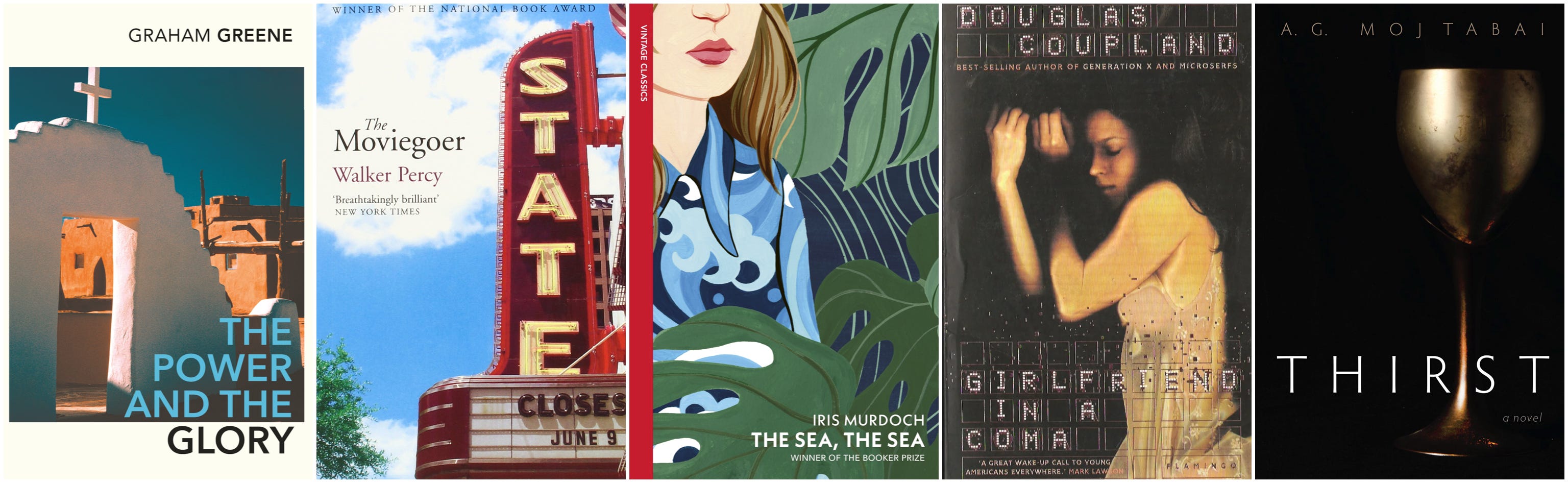
Graham Greene’s THE POWER AND THE GLORY (1951): OK — he’s here for the 2nd time. But this is my favourite Greene. The anonymous whisky priest is a superb creation, on the run in 1930s Mexico most communistic state. In fact, he’s the last priest alive. And by his own admission, he’s the most unworthy and flawed priest, an alcoholic and father of a young daughter. And yet, it is precisely because of his flaws that he is the character that is most human and most full of grace of perhaps any that flow from Greene’s abundant imagination.
-
Walker Percy’s THE MOVIEGOER (1961): Walker Percy would go on to write more after this debut (I was very struck by The Thanatos Syndrome), but this made his name and introduced many themes (existentialism was a major interest to this Southern Catholic convert). The rather comically (for this Brit) named Binx Bolling is a troubled veteran, desperately searching for meaning and purpose in New Orleans, with a difficult family background and a string of failed relationships. It is powerful and poignant.
-
Iris Murdoch’s THE SEA, THE SEA (1978): I have not always found Murdoch easy, perhaps because I lack her rich philosophical background. But this is an extraordinary novel about a famous actor-manager who’s retired to the coast where he meets and becomes obsessed with his first love. A piercing exploration of the unreality of our fantasies and assumptions about other people. A compelling story of broken idols.
-
Douglas Coupland’s GIRLFRIEND IN A COMA (1998): Very different style now, and more popular, but no less piercing for that. Taking a cue from The Smiths’ song, the main character went into a coma when hanging out with some other Vancouver school friends, and doesn’t wake up 17 years. Life has moved on – but the world is also about to end! Which means the book is a multilayered, part-dystopia, part-coming of age, part-postmodern youth culture depiction. Coupland is always at his best when trying to figure out what makes people and, the culture they inhabit, tick.
-
A. G. Mojtabai’s THIRST (2021): Can’t for the life of me remember why I picked this up. But it’s a remarkable novella by a writer I’d never heard of. A sceptical woman is called to help at her dying brother’s bedside, thus dredging up all kinds of family history, old resentments and personal confusion. Because her biggest challenge is that her brother has been a Catholic priest for most of his working life. Very moving indeed.
5 Books: Faith amidst all the Flaws
-
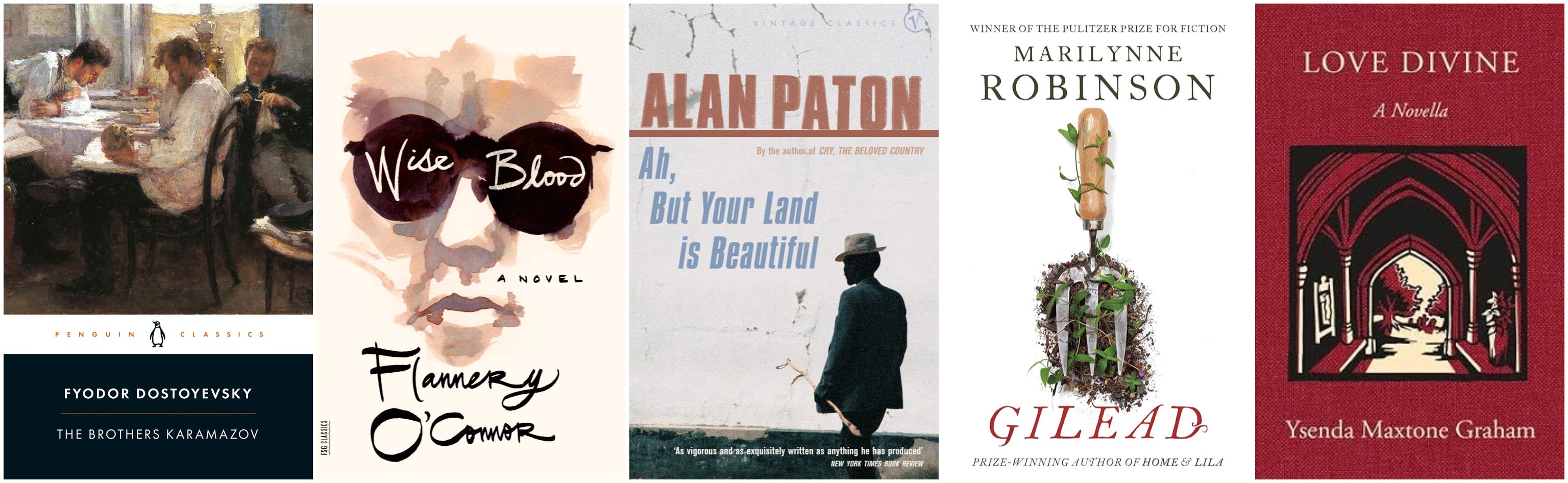
Fydor Dostoyevsky’s THE BROTHERS KARAMAZOV (1879): I said I was scared of the big Russian novels and this is no exception. But it is undoubtedly epic and brilliant, I grant you that. The roguish Fyodor has three sons (or is it four?) from two marriages and they are raised apart. But where there’s a will, there’s a family and the age-old problem of the inheritance is a key catalyst. I’m not even going to attempt a plot summary – but it does repay working at. Wow.
-
Flannery O’Connor’s WISE BLOOD (1968): By another Southern Catholic, this is O’Connor’s masterpiece and is full of grotesques and sinners, with characters dissembling and deluding til the cows come home. But it is still full of great humanity despite the religious fraudsters that is so characteristic of (but hardly unique to) American protestantism. Unforgettable.
-
Alan Paton’s AH, BUT YOUR LAND IS BEAUTIFUL (1983): You’ll no doubt know of his celebrated Cry The Beloved Country, a superb depiction of life in apartheid South Africa. But this later novel is my personal favourite of his. Set just as the grim apartheid mechanism of the 1950s Pass Laws came into force. Paton was an activist against the National Party’s regime and the novel is inspired by the period in which he was Liberal Party president. I’ve never forgotten the scene where a Supreme Court judge attends a black church for their Maundy Thursday service of communion and foot-washing.
-
Marilyn Robinson’s GILEAD (2004): It’s not everybody’s cup of tea because it is undoubtedly a slow burn. But who could have predicted that a fictitious autobiography of a dying 1950s pastor (for his 7 year old son who would never really know him) would become such a global blockbuster. But it did, in part because of its beautiful writing and deep humanity. I have at least one friend who went into ordained ministry in part because of it.
-
Ysenda Maxtone Graham’s LOVE DIVINE (2025): A surprise, this one; recently published by Slightly Foxed (of whose quarterly magazine I’m an avid subscriber), I was a little bemused as I got into this. It seemed a rather niche and quaint tale of folks in various orbits around a Home Counties Anglican parish during its interregnum between vicars. But it builds into a convincing and empathetic novel that I found deeply affecting.
5 Books: Windows into wider culture(s)
-
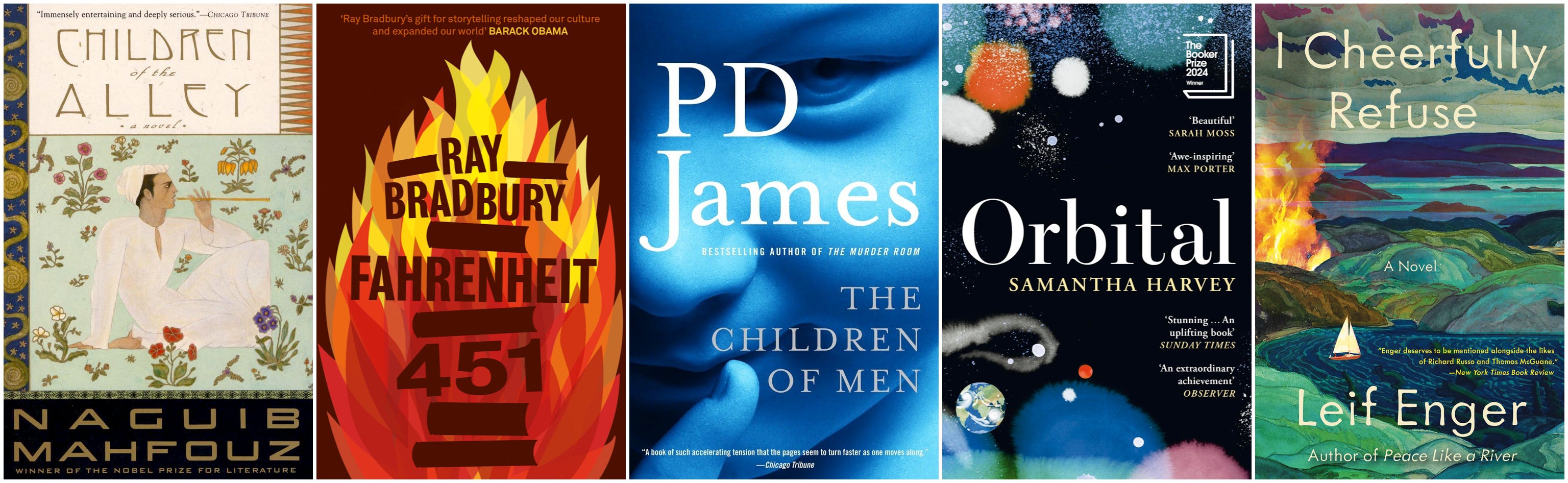
Naguib Mahfouz’s CHILDREN OF THE ALLEY (1959): A Palestinian friend recommended this unusual novel, by the Egyptian Nobel Prize winner Naguib Mahfouz, and I’m so grateful to have read it. A fatwa was put out after its 2nd English translation, and Mahfouz was attacked as a result. It is a shifting and subversive novel (aka Children of Gebelawi), and it took me a while to figure out what was going on. But through the lens of life in one Egyptian alley over several generations, Mahfouz loosely weaves the story of the 3 Abrahamic religions, against the constant threat of dictatorship and power-brokers.
-
Ray Bradbury’s FAHRENHEIT 451 (1953): A classic dystopia about book-burning as social control, which also has featured on Triptych. It feels more relevant than ever, of course, as screen based brainrot threatens to destroy people’s cognitive ability and independence—which is precisely what has happened to several in the book. But isn’t it striking how often the living libraries (those who memorise texts to keep them in circulation) carry within them whole books of the Bible as well as Shakespeare and other classics?
-
P. D. James’ THE CHILDREN OF MEN (1993): PD James was taking a break from her normal sleuthing with Adam Dalgliesh (I nearly included one of those here — her Original Sin (1994) is especially good) and I was utterly transfixed when it first came out.. The film adaptation is a true classic (even as it changes some key plot elements), but this vivid dystopia is a fascinating thought experiment. Set after a global pandemic of infertility, the human race essential waits for death. James is masterly at depicting the effect on a world without a future to speak. Until suddenly, a woman becomes pregnant…
-
Samantha Harvey’s ORBITAL (2023): 6 astronauts live in the International Space Station, and this novel depicts 24 hours in which they orbit the earth 16 times (each orbit takes 90 minutes). This is fiction set in space, as opposed to science fiction, as it were, and the result is a beautiful meditation on the beauty of the cosmos, common humanity and the questions of God, life and meaning. Wow.
-
Leif Enger’s I CHEERFULLY REFUSE (2024): Finally, another Triptych title, this time by the American novelist Leif Enger. Another dystopia, but without the clarity of a cause or even obvious consequences narrated; instead people in America’s Great Lakes muddle through life as people always have; but the key to the resilience of the recently bereaved protagonist is a refusal to give into despair. There is hope through beauty, through connections with others and through perseverance.