
I have sometimes wondered whether I should have read Modern History at university. But the thought never particularly appealed to me when making my choices for some reason. So it’s one of the areas for which I feel the constant need of gap-filling and depth-exploring. I have a rule of thumb that if I’m working somewhere new, I try to read a relevant work of history and of fiction (the latter ideally from that place) before I go. It has stood me in good stead over the years.
So here goes: a highly amateur selection of favourites.
5 Quirky Histories: PLACES
-
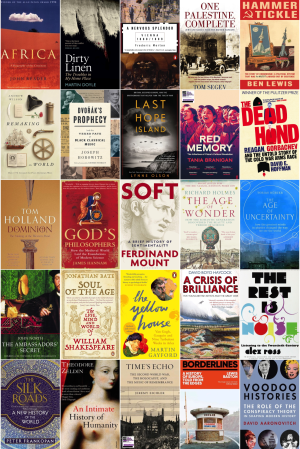
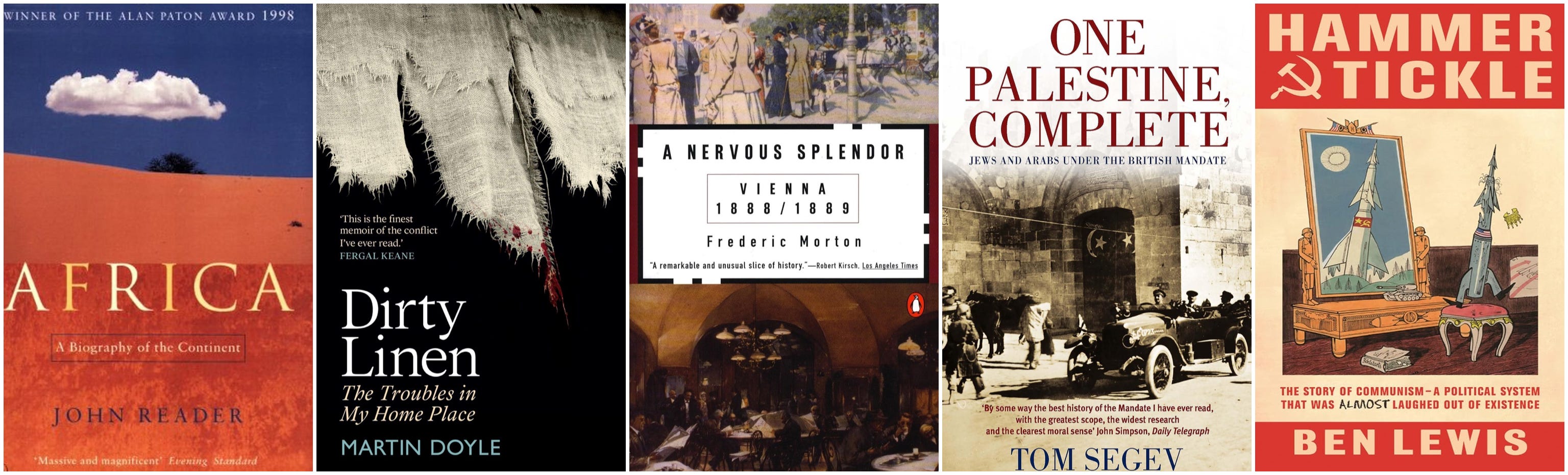
AFRICA: John Reader’s Africa: A Biography of A Continent: Read while living in Uganda, Reader covers an entire continent throughout the entirety of human history. So not really an ambitious book at all. But he does a brilliant job. And especially important is his dismissal of the absurd notion in some quarters of Africa ‘not really having much history.’
-
ULSTER: Martin Doyle’s Dirty Linen: The Troubles in my Home Place: Very much closer to home, Doyle’s study is just one Catholic parish in Armagh, Northern Ireland during the 25-year ‘Troubles’. Every murder and atrocity caused spirals of grief, and Doyle is remarkably even-handed and empathetic as he meets the survivors bereaved from all sides. Heartbreaking always, but occasionally hopeful too.
-
VIENNA: Frederic Morton’s A Nervous Splendour: This is one of a pair of unique books that delve into a 12-month period in the life of Vienna (the other is Thunder at Twilight). Everyone was there: Freud, Mahler, Klimt, Herzl, Lenin, Hitler, Trotsky, Stalin!! The first leads up to the murder-suicide of the Crown-Prince and his lover at Mayerling in 1889, the second up to the assassination of the next Crown-Prince in Sarajevo in 1914. Both superb, but the first is (only marginally) better (for reasons I can’t decide!).
-
BRITISH PALESTINE: Tom Segev’s One Palestine, Complete: After the collapse of the Ottoman Empire, much of it was divvied up between Britain and France, with the newly formed League of Nations mandates. Eminent Israeli journalist and historian writes about the 3 decades in Palestine under British rule before the formation of the Israeli state. Fraught, complex, tragic. A brilliant account.
-
COMMUNIST EUROPE: Ben Lewis’ Hammer & Tickle: I love communist jokes. And I’m fascinated by the Communist east. Lewis’s ingenious idea is to trace the history of both through the telling of (often illegal) jokes, many of which can be dated very specifically. Very funny and informative.
5 Quirky Histories: MOMENTS
-
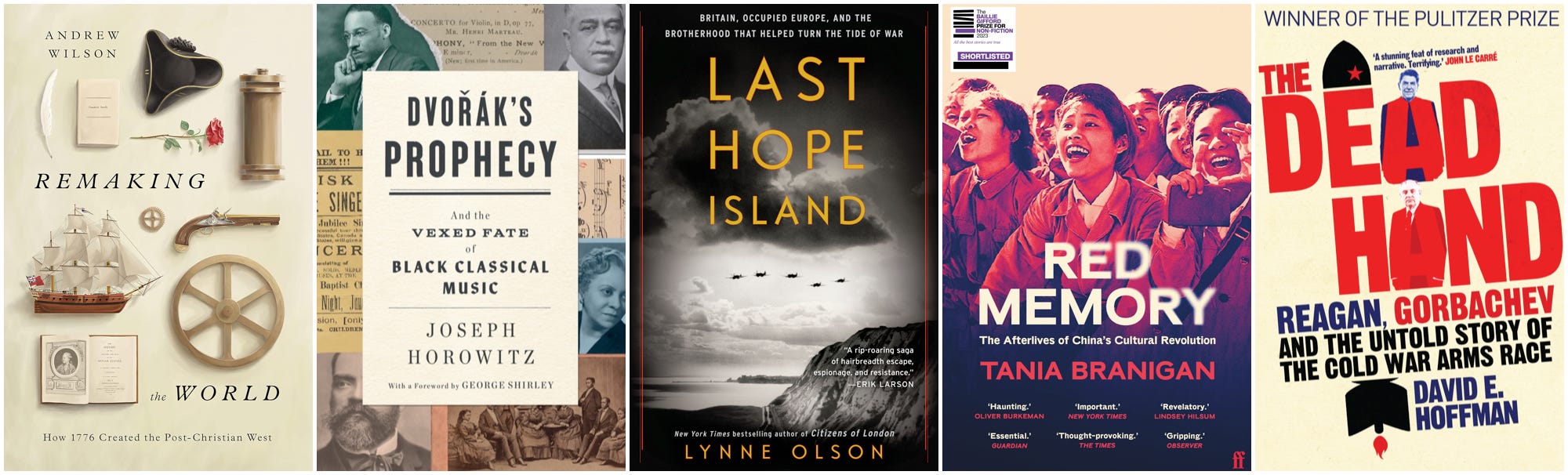
1776: Andrew Wilson’s Remaking the World: I was sceptical when I heard about the concept (that many aspects of the modern world can trace their origins to this one year). After reading it, I was fully convinced and actually jealous! I surprising and utterly compelling narrative, making for superb cultural history and a profound contribution to Christian apologetics.
-
1893: Joseph Horowitz’s Dvořák’s Prophecy, the Vexed Fate of Black Classical Music: I love Dvořák’s music but I had no idea about his impact in the USA (everyone knows his New World Symphony, even if only from Hovis Bread adverts). He was brought over from Czechia to New York by a philanthropist with a vision for creating truly American music. He came for only 3 years, but his legacy was profound, especially on African Americans. It’s a legacy that white America has really taken another century to acknowledge.
-
1940-44: Lynne Olson’s Last Hope Island: as the nations of Europe fell into Nazi hands like dominoes, many governments in exile retreated to the last redoubt in the region: Britain. In 1940 there was no guarantee, of course, they would be safe there either. But this fascinating account looks into how these various administrations operated, both with or without British support.
-
1966-76: Tania Branigan’s Red Memory, The Afterlives of China’s Cultural Revolution: I’ve never been to China so it somehow feels inconceivable to me. Too huge, too weighty and historic, too alien. And yet it holds a clear fascination. The Cultural Revolution was seismic and terrifying, a phenomenon which even 50 years on is still hard to grapple with (esp. with official censorship). Branigan does a remarkable job of digging, sifting, and reconstruction. Unforgettable.
-
1985: David Hoffman’s The Dead Hand, Reagan, Gorbachev & The Cold War Arms Race: How close did we come to Nuclear Armageddon? More to the point, why on earth didn’t we? A gripping account of the key players at the end of the Cold War and the 100s of others on all sides who played their part.
5 Quirky Histories: IDEAS
-
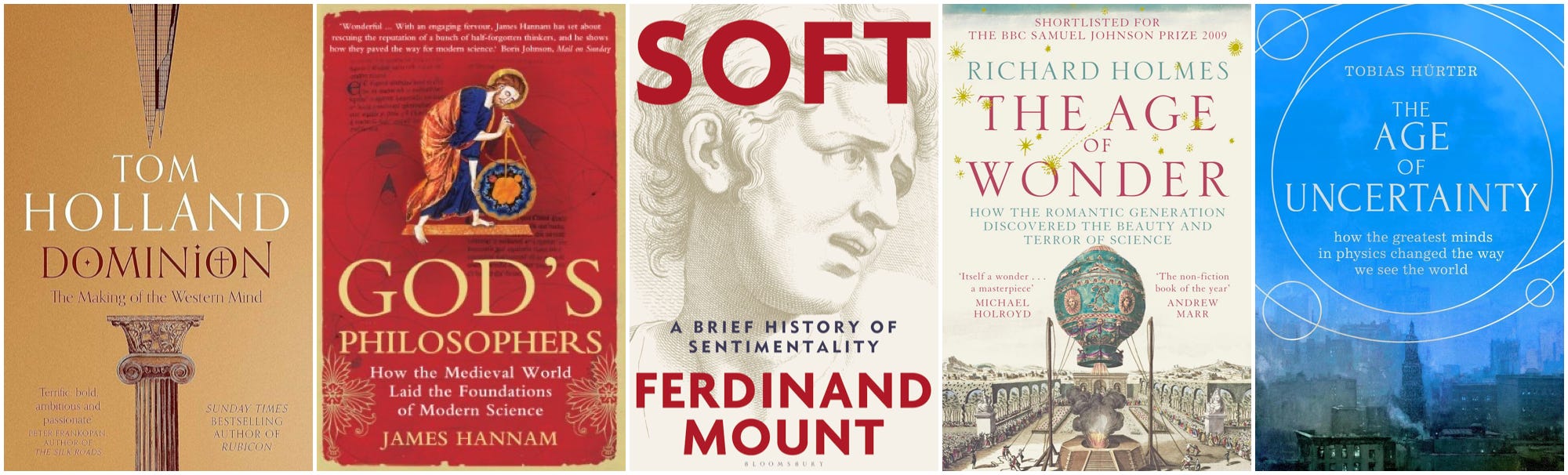
Tom Holland’s Dominion: The Making of the Western Mind: this has rightly won plaudits and been widely read. Unputdownable and thrilling, Holland explains why the modern west owes far more to its Christian roots than even Christians recognise. This is a vital, and inspiring, record.
-
James Hannam’s God’s Philosophers: How the Medieval World Laid the Foundations of Modern Science: When Newton said he could see so far because he stood on the shoulders of giants, the enlightenment propagandists assured us that he was referring to the Ancient Greeks. Not a bit of it. Hannam shows how significant, let alone advanced, Mediaeval science was, not in spite, but as a result, of its theistic framing.
-
Ferdinand Mount’s Soft: A Brief History of Sentimentality: Ferdinand Mount has a brilliant, eagle-eyed erudition that draws threads in the most surprising ways. Why anyone might want a history of sentimentality was beyond me, until I read this and it makes perfect sense. Surprising and eye-opening, he makes a compelling case for empathy for others, in part by exposing the consequences of its rejection (through a classical indifference and disdain).
-
Richard Holmes’ The Age of Wonder: How the Romantic Generation Discovered the Beauty and Terror of Science This is one of my favourite history books of all. I’d always assumed the Romantics rejected science as integral to their rejection of Enlightened reductionism. Not a bit of it. The likes of Coleridge and Wordsworth were fascinated by science and regularly attended public lectures at The Royal Institution by Faraday et al. All of which makes much more sense of Mary Shelley’s Frankenstein.
-
Tobias Hürter’s The Age of Uncertainty: how the greatest minds in physics changed the way we see the world: I am no scientist. And much of this book went over my head when it was describing the crazy world of subatomic science. But the human story I very much appreciated, learning a lot about the interactions of the biggest names of the century, Einstein, Heisenberg, Schrödinger, Curie, Bohr, Planck. Just wow.
5 Quirky Histories: ARTS
-
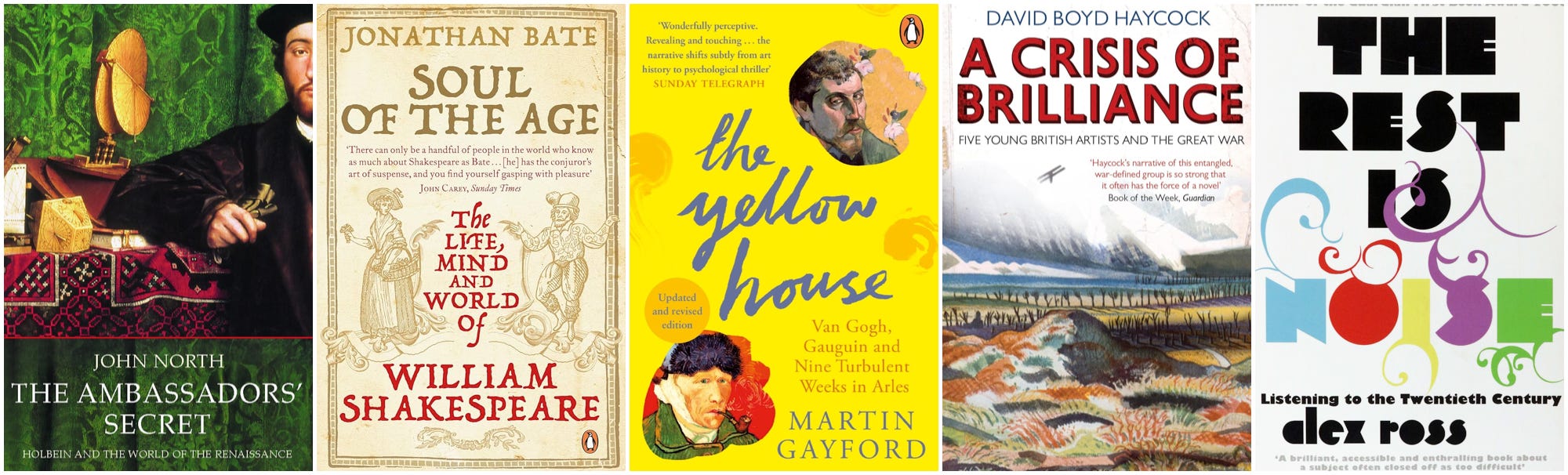
Holbein: John North’s The Ambassador’s Secret: The story of one painting in the National Gallery, Holbein’s Ambassadors. How can one painting warrant an entire book. Well, the painting is a puzzle that triggers a myriad interpretations and decodings. It reads like a real life detective novel, opening windows into the continental earthquake that was the Reformation. Brilliant.
-
Shakespeare: Jonathan Bate’s The Soul of the Age: I love Jonathan Bate’s books. He has made the study of Shakespeare his life’s work and here makes a convincing case for the grammar school Stratford boy being the playwright by simply combing through all the cultural and educational influences that someone of that background would encounter. He examines school curricula and common ideas in circulation. These are all then mapped onto the plays and poems with precision. What a great way to be immersed into the life of late Tudor England.
-
Gauguin & van Gogh: Martin Gayford’s The Yellow House: Two very different artists who tried to make a fruitful artistic partnership in Arles, in France, but which was perhaps doomed from the start (temperamental differences, contrary expectations, the intensity of their labours, a natural competitiveness). Martin Gayford plots out each day of the 3 months that would be the most productive of both men’s lives.
-
5 Slade Artists: David Boyd Hancock’s A Crisis of Brilliance: The Slade School of Art in London has had a remarkable influence over its 150 years of existence. This book studies 5 Slade contemporaries (Stanley Spencer, Paul Nash, Mark Gertler, Richard Nevinson and Dora Carrington) who became war artists in the First World War and assesses the war’s impact on their work and lives. Devastating and inspiring in equal measure.
-
Modern Classical Music: Alex Ross’s The Rest Is Noise—Listening to the Twentieth Century: Why did Classical Music shift from being popular and populist to niche and avant-garde? More to the point what music was being written and what was it seeking to do? Alex Ross is the long-standing Music Critic of the New Yorker and he makes 20thC music wonderfully accessible and interesting. There’s loads you will want to check out for yourself as a result.
5 Quirky Histories: REAL QUIRKS
-
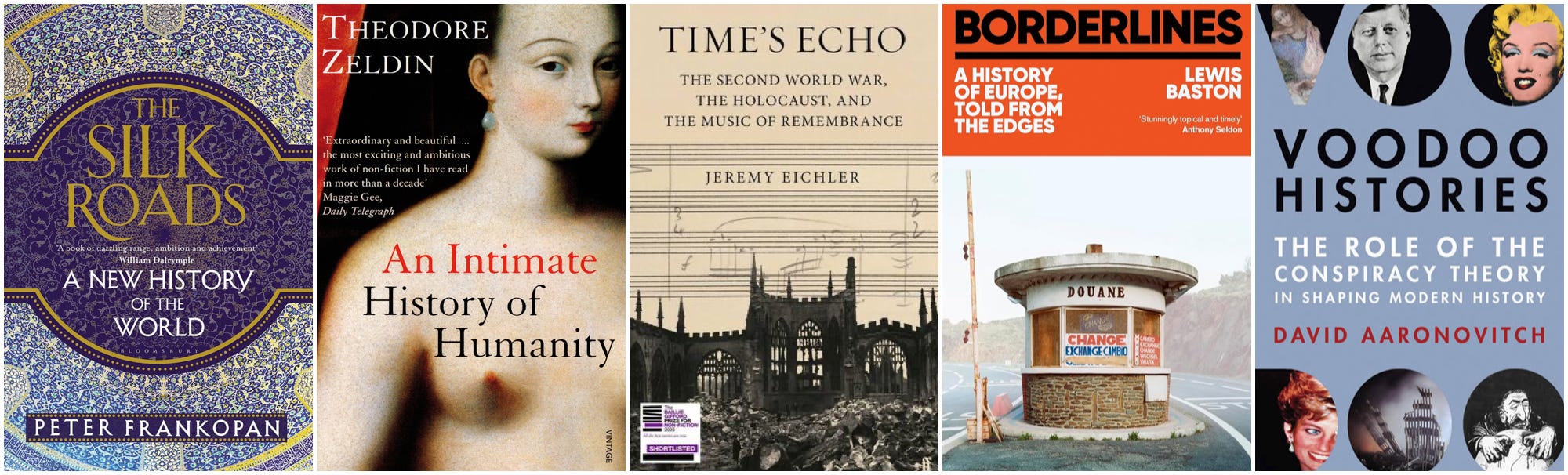
Peter Frankopan’s The Silk Roads: A New History of the World: I’ve known Peter for decades and was stunned when this came out. He has astonishing breadth in his knowledge, understanding and scope; the result is a book that realigns impressions of global history especially for those with a Western/Eurocentric bias. I’d never have known he had it in him!
-
Theodore Zeldin’s An Intimate History of Humanity: One of the first books on this list that I read. Truly quirky, but again grappling with history on the grandest scale. How has society changed, how do men and women relate to one another, what matters to different cultures, etc? Fascinating questions all. But what makes the book genuinely surprising is that each focus is told through the lens of a different historical woman.
-
Jeremy Eichler’s Time’s Echo: Music, Memory, and the Second World War: Another war and its impact on creative people, but this time musicians after the Second World War: Shostakovich, Britten, Schoenberg, and Strauss each wrote music to respond and/or memorialise. Precisely what quirky history books should do, opening up a corner of life and experience that one would never think to explore.
-
Lewis Baston’s Borderlines: A History of Europe Told from the Edges: Unlike many of the post-colonial regions of the world (that often have completely bonkers borders drawn on a vast scale), Europe has scores of borders that are bonkers at the opposite end of the spectrum. Soooo interesting and explains so much about the region.
-
David Aaronovitch’s Voodoo Histories: the role of Conspiracy Theory in Shaping Modern History: Aaronovitch takes the 20 most influential conspiracy theories of the last 100 years and analyses their roots, commonalities, and dangers: from the Protocols of the Elders of Zion to Princess Diana’s death, via JFK and the moon landings. So helpful and needed now more than ever.