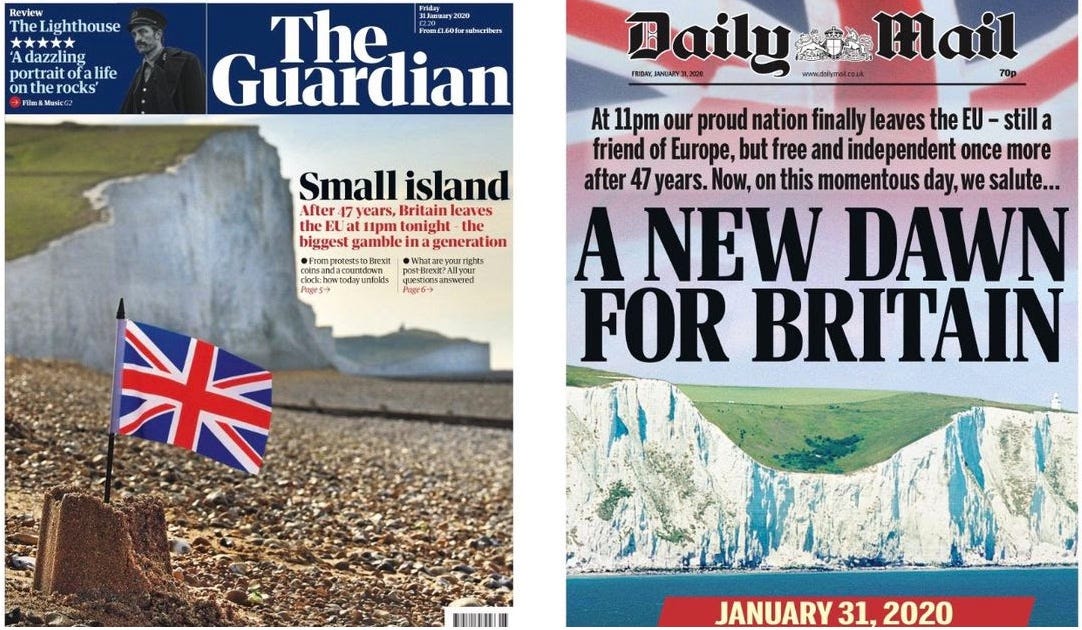
A decade ago, I wrote a handful of posts about the Brexit Referendum that took place in June 2016: two were written before the vote; another 10 months after it.
It felt like a seismic shift had taken place, one whose consequences are still vague and unclear. I vividly remember taking the Eurostar for some meetings in Paris a week or so after the vote. The French conductor rather pointedly announced:
Welcome to the Eurostar service for Paris, from London St Pancras (rhyming it with gone-bla!) to Gare du Nord, in Paris, France, EUROPEAN UNION.
As I made clear then, I wasn’t a huge fan of the EU as an institution per se, but I was definitely a fan of staying in it. So I re-read what I wrote then and have been trying to figure out what to make of it all now. I wasn’t getting very far, so I politely asked Claude.ai to sift through them to see what arguments still stand up now. The result was quite interesting.
These points hold up strongly
-
Your core claim — that leaving meant years of uncertainty and economic cost, not the promised prosperity — is well supported. The pre-referendum forecast of a ~4% long-run GDP loss proved close after five years but too optimistic longer-term; recent work estimates that by end of 2025 Brexit had cut UK GDP by 6% to 8%, investment by 12–13%, and productivity by 3–4%.
-
Your named culprit was right too: leaving generated a persistent increase in uncertainty, weighing on investment in particular.
-
Your prediction that new trade deals wouldn’t compensate held — the OBR judges new non-EU deals will not have a material impact (offsetting the loss by ~0.2%).
-
Your point that migration wouldn’t actually fall was prescient: the OBR now assumes net migration settles at 340,000 a year, far above the near-zero originally modelled (though the mix shifted from EU to non-EU).
-
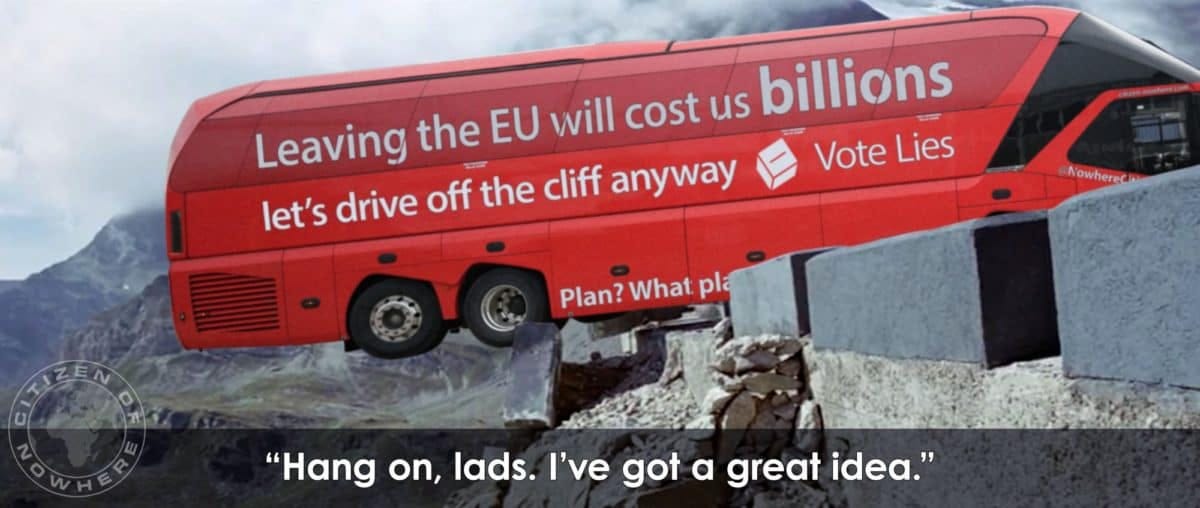
Your verdict that both campaigns were dishonest — the £350m/week NHS bus especially — is now uncontroversial
-
Your theological and cultural arguments (kingdom over union, welcoming the stranger, nationalism as danger) aren’t testable by outcomes. But the rise of populism exploiting a real democratic deficit lends your instinct some retrospective weight — but that may reflect your priors as much as vindicate your reading.
This is gratifying at one level bearing in mind that I’m no PolSci/Econ expert by any stretch. But that’s hardly encouraging.
This point partly holds up
-
Your union warning was half-right: Scotland did vote Remain and constitutional tension followed — but your “rump state of England and Wales” scenario hasn’t materialised. The Supreme Court blocked a unilateral referendum (2022), the SNP lost 39 seats in 2024, and by 2025 the SNP had reportedly dropped its referendum demand. Still genuinely open, though — the SNP won a fifth Holyrood election in May 2026 and keeps pressing.
OK, fair – but Claude doesn’t take into account the terrible consequences for Northern Ireland and the real risk that there would be a return to violence with the restoration of a hard border with the Republic. The Windsor Agreement did something to alleviate it, but it has exacerbated the Union’s inherent instability. It is surely not incidental that the regional administrations of Scotland, Wales and Northern Ireland are ALL now led by separatist parties.
We’re definitely not out of the woods yet.
Then Claude pulled together some more contentious aspects
Where you were overcautious or lucky or unverifiable
-
Calling the economics “reasonably evenly balanced” in 2016 now looks too even-handed — the Remain economic case was stronger than you allowed.
-
Your “UK would become the EU’s biggest economy” line rested on a speculative projection and is now moot.
-
Brexit’s defenders would still argue: the counterfactuals are unfalsifiable and absorb Covid and the energy shock; sovereignty and self-government are real goods invisible in GDP; migration control was regained in principle; and the 2020s exposed EU fragilities a member UK would have shared. Whether that outweighs a multi-percent GDP drag is the honest debate — still argued largely on the terms you set.
-
Every figure rests on a counterfactual (the UK that never was), which is inherently uncertain, and Covid plus the 2022 energy crisis blur the picture. Treat specific numbers as approximate; ranges run from ~4% (OBR) to 6–8% (recent studies).
At the time, I couldn’t help feeling that the biggest winner in it all was Vladimir Putin. And that was before we knew more about the FSB’s troll-farms etc. A divided Europe is a marginalised Europe and that could have desperate consequences for everybody. I can’t help thinking that Putin would have been delighted with the ways in which his disruptions have gone, starting with the annexation of Crimea in 2014. It’s only in recent months that the quagmire that his Ukraine campaign has become is obvious to all. The problem is he only needs to persevere in pummelling the country and feeding countless troops into the meat grinder in order to win. Ukraine has to win the battles and most of the skirmishes every time.
Looking back now
I remain no unalloyed Europhile. I was profoundly glad we never joined the Euro. The Brussels machine still needs a good kicking. But I said in 2017 that we — and the EU, and the world — were better off with Britain in, and nothing in the decade since has shifted me off that.
If anything, I’m sorrier than ever to have been right about the bits I got right. It’s one of those occasions when I just wish I had got it wrong.