
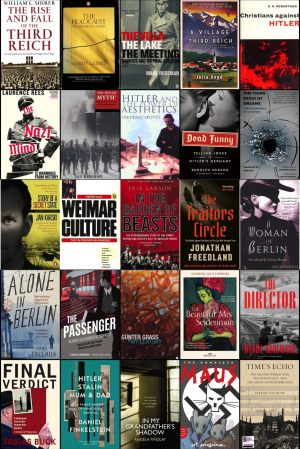
Having offered some reading that has informed my own fiction writing (about life in East Germany) the other day, here is some background reading. You simply cannot understand the reality of the GDR without recognising the Nazi ashes from which it arose. So here goes (again amateur, personal and not exhaustive):
5 books: Nazi-era History
-
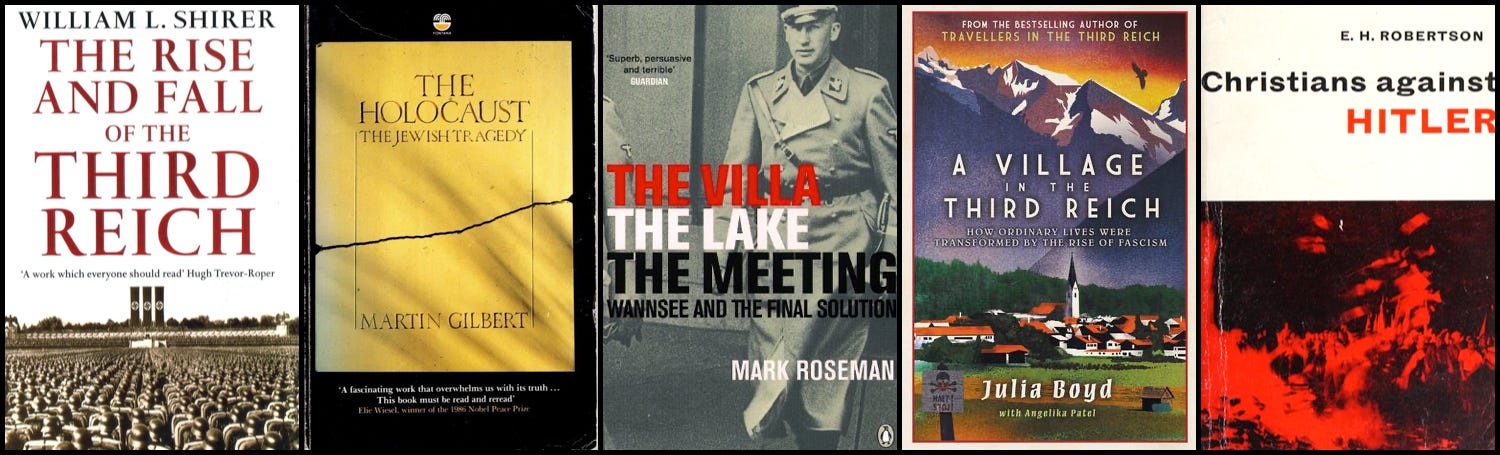
William Shirer’s The Rise and Fall of the Third Reich: this is the granddaddy of them all. First published in 1960 it has never gone out of print. It’s a hefty tome (coming in at roughly 1250 pages) but then it’s a big subject. But it’s not without its critics (esp. in Germany) and it is journalistic more than scholarly.
-
Martin Gilbert, however, was a scholar (in particular of Winston Churchill) and his The Holocaust: The Jewish Tragedy is gruesome but vital and unforgettable. It’s another doorstop (at 900pp) but it is so important. It makes the noxious gases of Holocaust denial as insubstantial as they are grotesque.
-
Mark Roseman’s The Villa, The Lake, The Meeting: on a completely different scale, thankfully, but still blood-curdling. This investigates what actually happened at Heydrich’s notorious Wannsee Conference at which the Final Solution was articulated and proposed. If you’ve not seen Kenneth Branagh et al’s extraordinary 2001 dramatisation, Conspiracy, you must.
-
Julia Boyd’s A Village in the Third Reich: Boyd had already written about foreign travellers in Nazi Germany and followed up with this in 2022. If you’ve ever wondered what it would have been like in your own context, drilling down on just one small community makes for a real eye-opener, and oh, so human. Scary.
-
E. H. Robertson’s Christians against Hitler: not particularly well-known book (or story for that matter) but a helpful window on the (minute) Confessing Church of the likes of Dietrich Bonhoeffer. It’s terrifying how few joined them but what courage.
5 books: Grappling with Nazi Culture
-
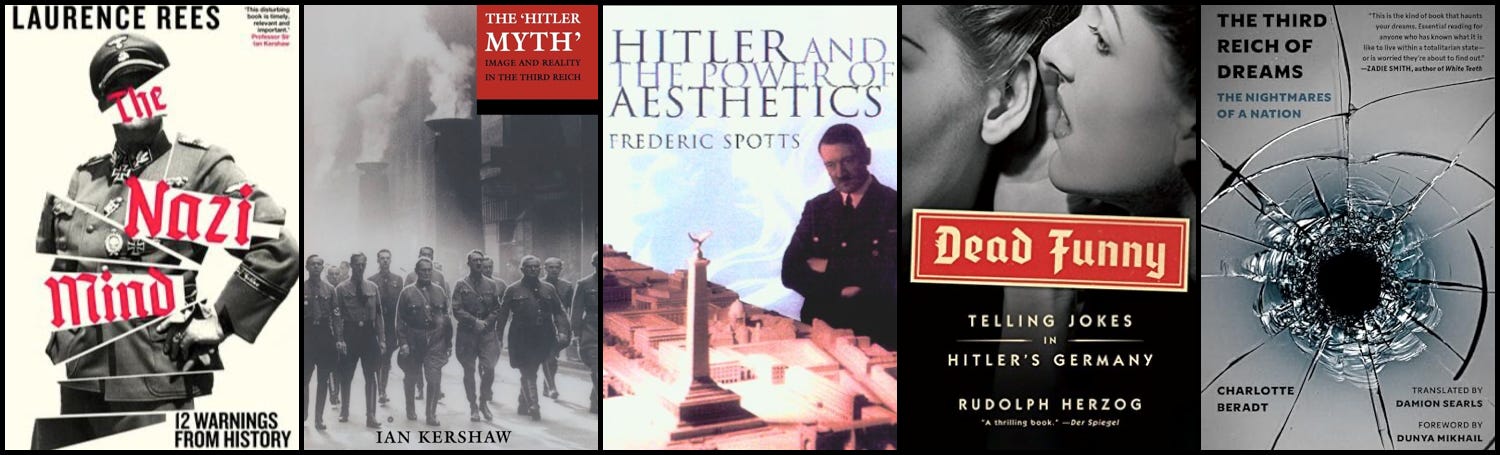
Laurence Rees’ The Nazi Mind: Rees has worked on this period for years, but his most recent (came out Jan 2025) is urgent and timely. He identifies 12 characteristics of the culture that produced Nazism, and drawing on psychological scholarship and new historical research, writes a truly eye-opening book.
-
Sir Ian Kershaw’s The “Hitler Myth”: Image and Reality in the Third Reich: a book I have frequently returned to and which I wrote up here for a very different project. Kershaw is one of the premier UK scholars of German history – and his premise is simple. Of the 7 myths people believed about Hitler, what was in fact true? Answer: not a single one.
-
Frederic Spotts’ Hitler and the Power of Aesthetics: this was recommended by a trusted friend but I wasn’t entirely convinced initially. However, it’s ingenious and surprising. He contends that Hitler was driven as much by an aesthetic vision for ‘Germany’ as a hideously racist one – which fits for someone who was a failed artist.
-
Rudolph Herzog’s Dead Funny: I’m fascinated by political humour. And this gives a bottom-up account of life in the Reich through the jokes that people told and suffered for it.
-
Charlotte Beradt’s The Third Reich of Dreams: Another quirky angle here, this time dreams. Of course, dreams reveal much about what people are actually thinking and feeling (sometimes despite themselves), so where people have recorded them, there is a rich vein to be found. Came out last year and is fascinating.
5 books: Personal Experiences of Nazism
-
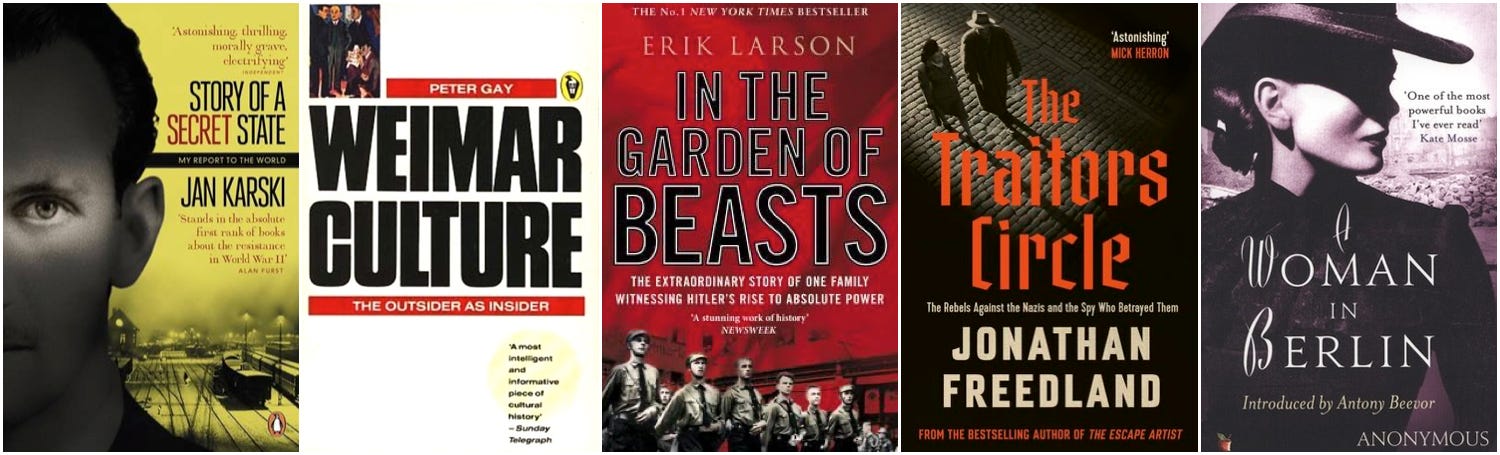
Jan Karski’s Story of a Secret State: What did the world know about the Holocaust before the end of the 2WW? Well, Karski was an extraordinary, courageous Polish student who found himself in the Resistance and then researching what was happening to the Jews. He took incredible risks and was even for a time a political prisoner in Auschwitz. And then he told the world. But would they believe him?
-
Peter Gay’s Weimar Culture: The Outsider as Insider: Just as Nazism is crucial for grasping the GDR, so Weimar is for Nazism. This is a short book but it helps to understanding the cultural climate that somehow made Hitler seem an attractive proposition.
-
Erik Larson’s In the Garden of Beasts: Love and Terror in Hitler’s Berlin: Larson has made a name from writing pacey and novelistic accounts of real events, and this is a brilliant example. He tells the story of the new US Ambassador to Berlin who arrives with his family in 1933 only to find that it is a world going insane.
-
Jonathan Freedland’s The Traitor’s Circle: Another out last year, the British journalist tells the fascinating story of a few individuals from the heights of German society who bravely tried to do something about Hitler’s mob. There were so few of them, and they could only do so much.
-
Anon’s A Woman In Berlin: a devastating book that, strictly speaking, belongs more to the immediately post-war era. But it is important because it shows just both how bleak the world left by Hitler was and how vulnerable it was to Soviet predations in 1945. This book is courageous and resilient, describing horrors you wouldn’t wish on your worst enemy.
5 books: Nazi-era Fiction
-
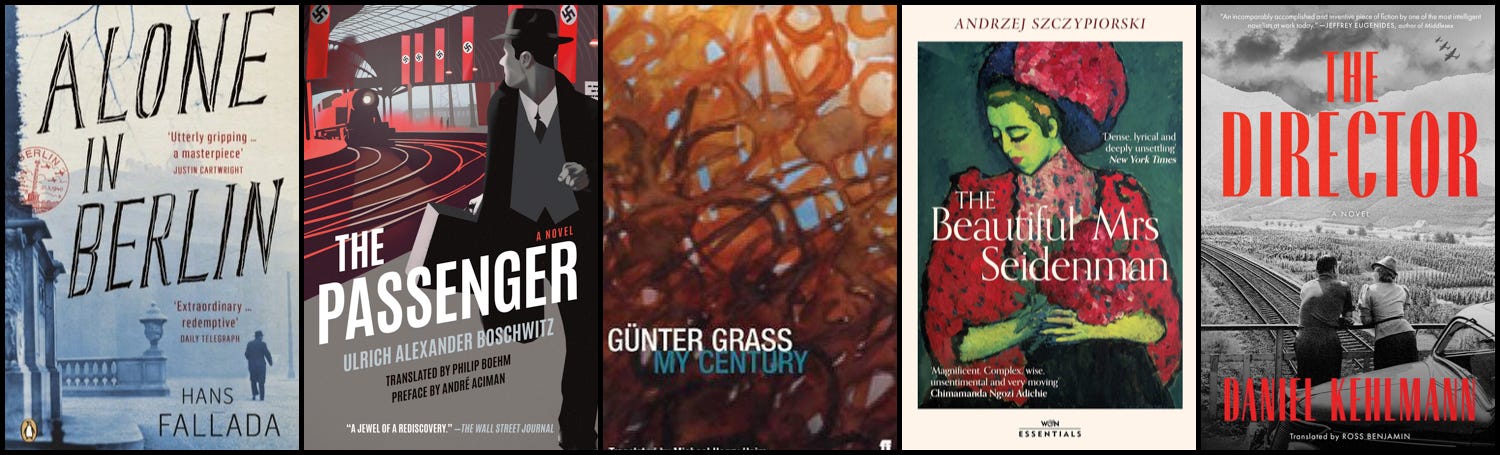
Hans Fallada’s Alone in Berlin (it’s UK title): unputdownable novel based on the true story of a couple who were devastated by grief for their son killed in France in 1940. So they defiantly deposited postcards at points around Berlin to speak out (quietly) against Hitler. A cat and mouse chase ensues…
-
Ulrich Alexander Boschwitz’s The Passenger: a man relentless tries to flee after Kristalnacht, but finds himself stymied at every turn. Vivid and chilling, Boschwitz’s novel was written in 1938 but was unknown to English readers until it was translated very recently. It perfectly captures the sense of claustrophic desperation of getting trapped in a shrinking world.
-
Gunter Grass’ My Century: one of Germany’s greatest writers, reflects on Germany’s 20th Century with 100 short stories and pieces that interlink and capture the splinters and fragments of a devastating time.
-
Andrzej Szczypiorski’s The Beautiful Mrs Seidenman: A Polish novel, now. I knew nothing about it but picked it up because of Chimamanda Adichie’s foreword. It narrates 36 hours after the life of a Jewish woman who can pass as Aryan. A surprisingly brilliant book.
-
Daniel Kehlmann’s The Director: G.W. Pabst was one of Austria’s greatest film directors who fled to Hollywood when the Nazis came to power. However, things didn’t work out well and so Kehlmann’s brand new novel imagines what it must have been like to return to Europe while Hitler was still in power. Some stunning writing.
5 books: The Nazi Legacy
-
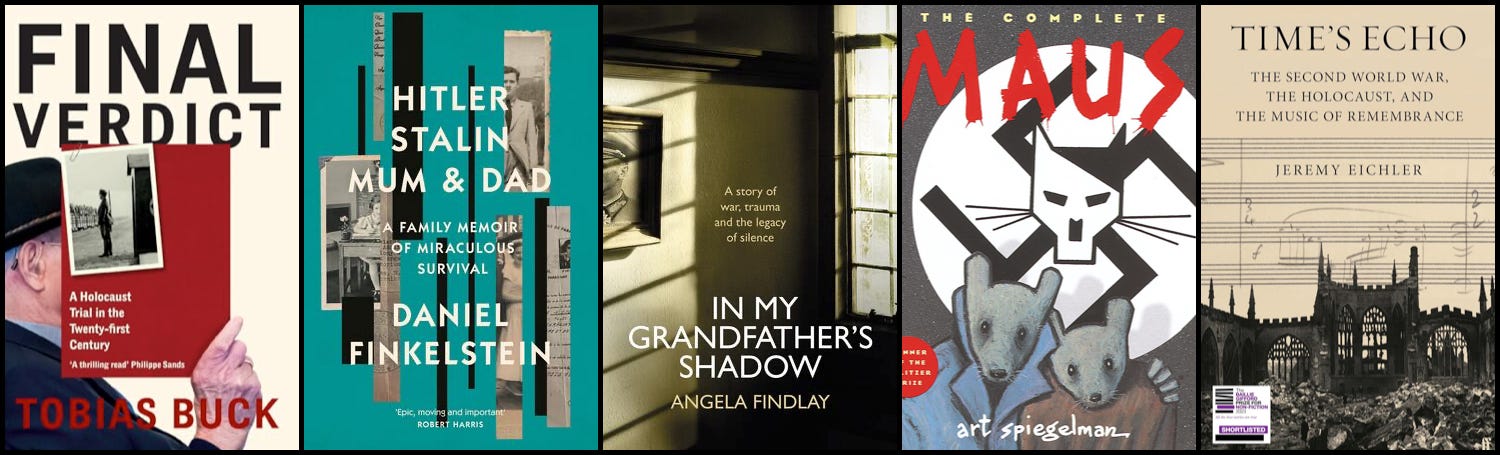
Tobias Buck’s Final Verdict: A Holocaust Trial: there are no war criminals left alive now. So Tobias Buck’s interest in the 2019 trial of Bruno Dey (who had been in the SS as a teenager when a terrible atrocity was committed) was motivated by the consciousness that it would be the last of its kind.
-
Daniel Finkelstein’s Hitler, Stalin, Mum & Dad: Finkelstein has been at the heart of Conservative Party politics for years but his family background is anything but establishment. The survival of this family in between the Scylla and Charybdis of the Nazis and Soviets is nothing short of miraculous. An extraordinary story.
-
Angela Findlay’s In My Grandfather’s Shadow: Findlay’s father was in the Royal Navy, her maternal grandfather was Wehrmacht General. Her personal story is full of poignancy and heartache as she tries to understand what it means to have inherited very different family legacies. This is a powerful book, not just because (full disclosure) Angela is a distant cousin.
-
Art Spiegelman’s The Complete Maus: I’ve not read many graphic novels but this has never left me. It is a masterpiece, depicting the experiences of Spiegelman’s father under Nazi rule. The genius is to tell the story through animals (mice represent Jews, cats are Nazis) and it is searing.
-
Jeremy Eichler’s Time’s Echo: Music, Memory, and the Second World War: this is very different. Eichler’s brilliant book examines how four composers— Shostakovich, Britten, Schoenberg, and Strauss—attempted to memorialise the war and their different responses reveals a great deal about their respective cultures. Just stunning.