

It’s only been 48 hours since I got home and I am missing Ukraine immensely. Leaving felt like a greater wrench than previously for some reason. I never go for more than 10 days, but especially in the full-scale war trips, they’re always intense. Unsurprisingly. But this trip has affected me more.
Since writing, I’ve had a number of conversations with friends about the previous post. But it was as I passed on this little anecdote to one or two that things crystallised for me.
Surviving through the Darkest Humour
I was happily munching on my Croissant-cheeseburger (yup, that’s a thing, now) in Lviv station’s branch of the simply excellent Lviv Croissants. The seats across the table were free and so before long, a young couple came to sit down. The man was evidently a veteran horribly injured in the war; but this must have been fairly recent since he seemed to struggle quite a bit with his prosthetic leg. He was still very reliant on his partner and she helped him slide in; so I can only assume that it was very early days of his adjustment. One of the challenges of several Ukrainian railway stations I visited is that the only way to reach platforms is via stairs. There precious few lifts or escalators around beyond the central station in Kyiv. It’s hard enough with luggage; I dread to think how stressful it makes things for the injured or elderly.
They sat chatting quietly while waiting for their food. I smiled and they smiled back but that was about it. But I couldn’t help notice when he got out his phone since the volume was quite high. He was showing her various videos and memes. One had a bunch of blokes talking very animatedly; presumably soldiers. And then very suddenly, there was an almighty explosion and it made her jump out of her skin. Mission accomplished, he was now in complete hysterics, while she looked vaguely tolerant.
Lacking any Ukrainian to speak of, I asked if they spoke English. Both said no. So I typed out on Google Translate, “Was that war humour?” He chuckled and nodded while she eye-rolled up to the ceiling in mock despair. This had not been the first time.
A lovely little moment of connection. As I got up to head to my train for the Polish border, I typed out, ‘Good luck and stay safe’. They said they were grateful and smiled and that was that. I wish I could have chatted properly, but I was glad that a small bridge at least had been built.
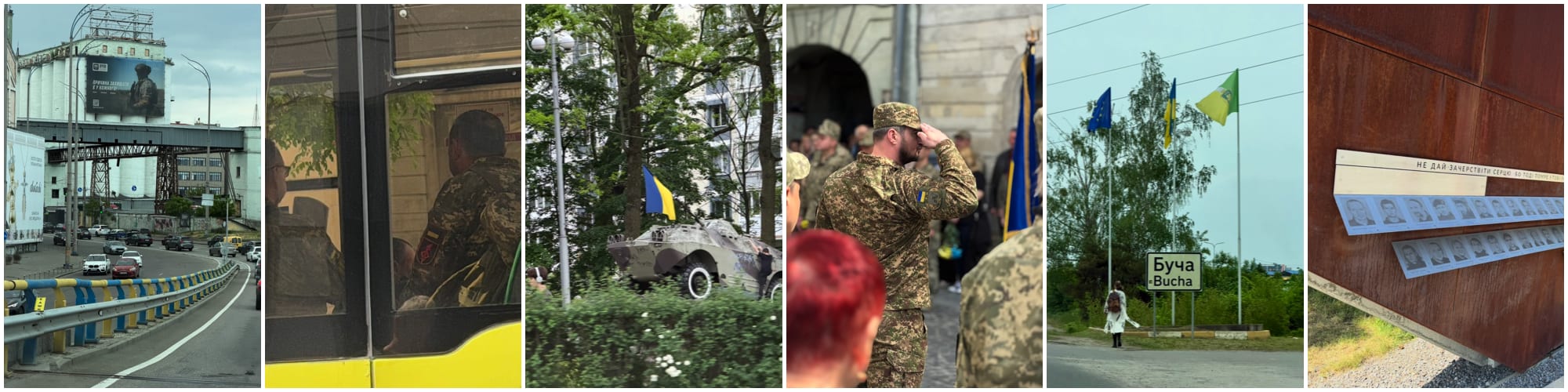
Afterwards, I realised it was yet another snapshot of how normalised violence and horror have become there. Of course, I do not begrudge soldiers their black humour since I know how important (let alone funny) it can be in all walks of life. Five minutes with a bunch of detectives, or ambulance drivers, or clergy, or primary school teachers… more or less any group in fact… will prove that. It’s a survival mechanism. But what if one forgets that it is dark in the first place? If it becomes the norm?
Living in a country under constant assault for 4.5 years and counting utterly debilitating and overwhelming. For those in the east and in the more vulnerable corners faces relentless real and lethal danger on a daily basis. As this 5-second clip shows…
These Shahed drones are not big-boys-toys. They’re killing machines. So what kind of impact is this going to have on a population long-term?
The Spirit of the Darkest Hour
It’s commonly observed that we in Britain are obsessed with the Second World War; after all, it’s one of the few topics left on our schools’ mandatory history curriculum. Banging on about it is seen is evidence of a nostalgia for a long-gone era of British power and resilience. If you want to know how low things can get here, for example, just listen to The Rest is History episodes on British politics in the 1974! Who wouldn’t want to allow that to be eclipsed by the heroism of fighting on alone in 1940 and glorious victory etc etc? I have no doubt that much of this nostalgia is unhealthy, and in fact can serve to fuel a populist rhetoric that is not so much worse as actually quite dangerous. It can lead onto the unrealism of magical thinking and simplistic hankering after the past.
But I just wonder if there is an additional element, often overlooked. Perhaps it’s also a residue of trauma that has kept it in the public discourse. My father was born in 1941, and even though the family was not in London but St Albans, the blitz would continue for another 4 years (albeit in different phases and degrees of intensity). Of course, he was too young to be fully aware of it. But for many from my grandparents’ generation, it was inescapable. And the way to cope was never to bring it up again. Keep on, Carry on, Say little. There’s probably much more to be said for it than the psychologists tell us. Especially if in the middle of the crisis. As Churchill once said (apparently),
If you’re going through hell, keep going!
But there will be costs and consequences to living through either London’s Blitz or Kyiv’s Onslaught. And if you also factor in chronic sleep-deprivation (which must be one of Ukraine’s greatest ailments currently) with the frequent experience of genuine jeopardy—and we’ve not even touched on the many griefs and agonies that are war’s inevitable fruit—then this will surely take decades to deal with. For sure, the heroism and resilience of Ukraine’s David standing up to Russias Goliath will fuel stories for generations. But so will the trauma. Even the tiny amount of time (comparatively) that I’ve spent in air-raid shelters has brought that home.
When the war ends—and please, Lord, may it be VERY SOON if not NOW—there is a harrowing and long road ahead. In large part, its goal will have to be denormalising the abnormal and renormalising the normal. Or another way of putting that, perhaps, is to strive after all the facets of that beautiful Hebrew word shalom. It’s too much for us. But there is one for whom it is not:
I have told you these things, so that in me you may have peace. In this world you will have trouble. But take heart! I have overcome the world. John 16:33
As it happens, I had a few spare hours before my train to wander around Lviv again. Glorious weather, stunning architecture, very buzzy atmosphere despite being Monday morning. And yet, just 3 days after the previous ceremony I witnessed, another military funeral was taking place near Rynok Square’s City Hall.
Which suggests that what really should be abnormal is even more normal than I’d appreciated.
(For more photos from this trip, check out my Flickr page).