

It’s always the things you don’t anticipate that get you.
I only have a measly few words of Ukrainian, so I miss almost everything. Natives catch nuances in snippets of conversation, tannoy announcements, and graffiti slogans. But these just pass us outsiders by. Walking around Ukrainian cities feels no different from 21st-century urban normality everywhere else. And in fact, Ukraine is technologically advanced, far more developed than most countries even in Europe (car charge-points are all over the place, for example). Everything is done online (from ID checks, bill payments and military conscription); billboard posters look incomplete without QR codes. So the world goes on and people carry on with life, minding their own business. Which means that we visitors do too.
Until something catches you out again and you realise, no, this really is not normal.
The unexpected things
I’ve just arrived from Kyiv on the 6½ hour train to Lviv, one of my favourite cities on earth. Just before the Arrivals Hall entrance once everyone pours down from the platforms, soldiers were stopping all the men to check IDs. Which is when you realise yet again that this is a country at war.
The one who stoped me rattled off a paragraph to which I could only meekly pipe up, ‘English?’ He replied sardonically in a thick accent without bothering with my passport, ‘Good luck.’ Almost as if he was disappointed. But it was over in seconds so I’m overthinking it. Men between 18 and 60 are not allowed to leave Ukraine without good reason; all between 25-60 without exemptions or deferral grounds may be mobilised at any moment; and moving around the country only makes one more vulnerable to getting identified. It’s not quite press-ganging per se; but it must feel like it.
Of course, I’m exaggerating somewhat. It’s impossible to ignore the invasion’s impact for long. It is a constant.
-
Billboards jostle for attention as they do globally: the usual things like phones and fashions, banks and brands… oh and regimental recruitments.
-
You encounter a buzzing street market comprised of all kinds of stalls (bric-a-brac, 2nd-hand clothes, military memorabilia etc) and a county-fair atmosphere. It looks fun and so you investigate. There’s a nominal entrance fee, of course. But then you realise the whole market is a fund-raiser for the army. Of course and that’s totally fine. But still. That’s not normal.
-
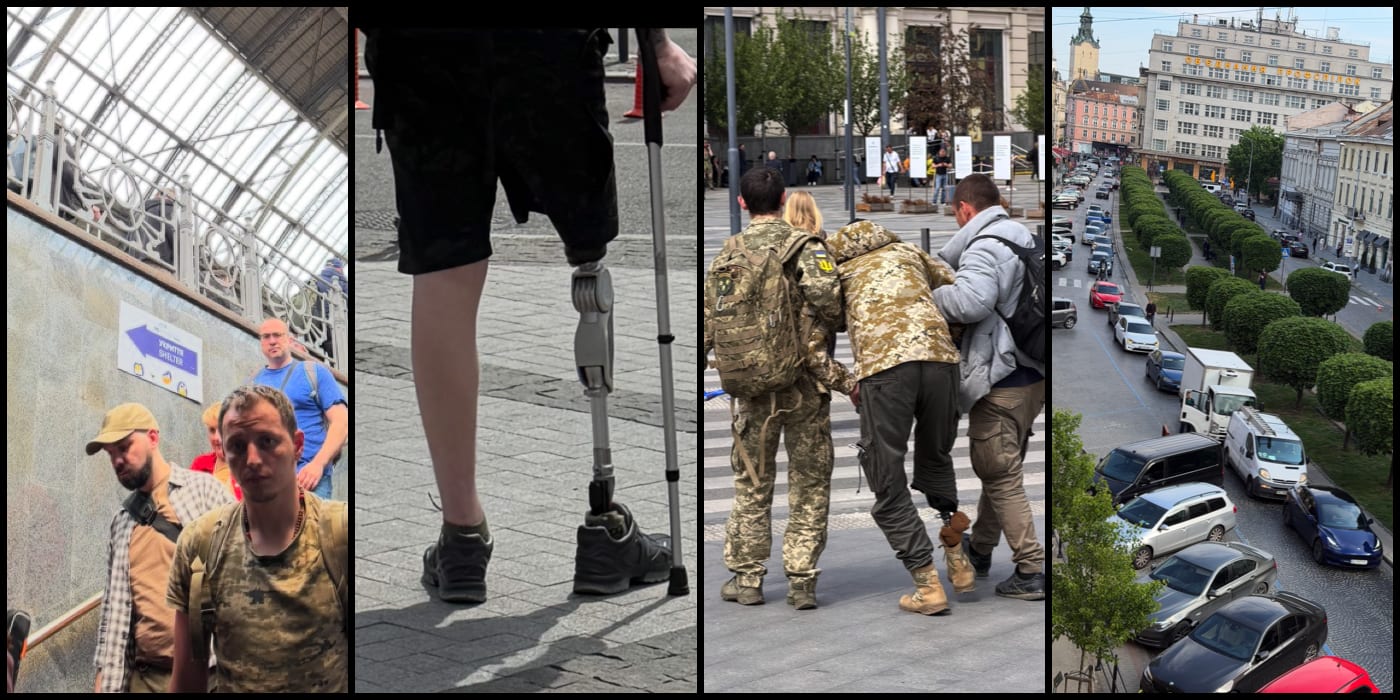
Stark, one-worded arrows, frequently fixed to walls: ‘SHELTER’. These are not because of extreme weather. This is wartime. That’s not normal.
-
There are the air-raid sirens, which previous visits have made them familiar. What does seem new this time is the prevalence in daytime. Those in eastern towns and cities have faced almost constant barrages; a kindergarten—yes, a kindergarten—was destroyed in Sumy. I’ve been staying in Kyiv where apartment blocks have been shelled and damaged. A friend lives just next to the one that got heavily bombarded just last week. In fact, there have been massive electric storms in Kyiv this week and one could be forgiven for thinking that the deafening thunderclaps were attacks. Irina said it’s ok, there are no sirens. So that’s how you know. That’s not normal.

-
The train wifi was strong and reliable (far better than the service on British trains). Except when it wasn’t. But there was a very specific reason for that, made clear on the log-in page. The wifi is turned off at various points to make the trains less trackable by drones. Having seen the husk of a targeted carriage in Kyiv Central Station’s small museum area, it’s not hard to grasp why people are not unhappy about it. That’s not normal.
-
I have probably seen more artificial limbs out ‘in the wild’ on this trip specifically, than in my entire life to this point. And you can tell that they are bright, sparkling new, with the latest prosthetic tech on display. That’s not normal.
-
Every morning at 9am PA systems call people to attention to honour the war effort and, more particularly, the war dead. In central Lviv, it was very striking this morning to see traffic stop on one of the main avenues and several drivers getting out to stand with bowed heads. That’s not normal.
Dark humour … or grim realism?
A funny moment during a teaching session.
I was explaining the difference between blind and reasonable faith. Suppose you want to get to downtown Kyiv urgently. You could, I suppose, run out into the street, wave down the first car you see and instruct the driver to take you there. Whether he or she agrees is not the issue; the problem is being completely ignorant about the driver.
Or, you could ask someone in your town with the reputation for being an excellent driver, with unblemished accident record and who has said previously ‘you only need to ask’. To choose the second driver, then, is actually quite sensible.
Now, you can think what you like about each driver, but you won’t prove your faith or trust in them until you actually get into the passenger seat. Up until then, it’s just words. But after, you’re exercising faith for sure. So far so good. And quite a fun, random discussion ensued about all the things that could go wrong or be wrong with the unknown driver. And then someone said, ‘and there could be a dead body in the car too’. Which was hilarious; everybody was rolling with that, as was I. Just the kind of absurdist, Pythonesque humour I adore. Talk about bad luck – I mean imagine jumping into the first car you see only to discover that this one happened to have a corpse in the back.
Incidentally, it reminded me of the story about eminent scientist, John Haldane. He suggested to a Roman Catholic priest that in a universe containing millions of planets, it was absolutely inevitable that life would appear by chance on one of them. ‘Sir’, replied the priest, if Scotland Yard found a body in the boot of your car, would you tell them, ‘There are millions of boots in the world; surely one of them must contain a body?’ I think they would still want to know who put it there.
But I was chatting with a friend afterwards and she pulled me up short. For you, this is a joke and is inconceivable because you don’t live in a war. If you did, it would be funny, but perfectly possible. That’s not normal.
Kneeling in solidarity
The slightest thing trips you up. I spotted an elderly man on a Kyiv street being hugged by his granddaughter. It was so simple but so human and so tender. It was several minutes before I recovered my sight unblurred.
But this morning, I was wandering in glorious sunshine — a cliché I know, but good weather seems so incompatible with war; the pathetic fallacy really ought to be true —heading into central Lviv this morning with plenty of time to kill before the next thing. A small gathering was forming, with several folks holding bouquets facing down (I wasn’t sure if this was a cultural thing or convenience). A few minutes later, they were joined by a small platoon walking in loose formation bearing Ukraine flags and a three soldiers’ portraits. It was only then that I noticed we were all outside a church and so I waited. About 15 minutes later, 3 police vehicles arrived carrying a coffin. And as they were carried into the church, everybody knelt down on the cobbles.
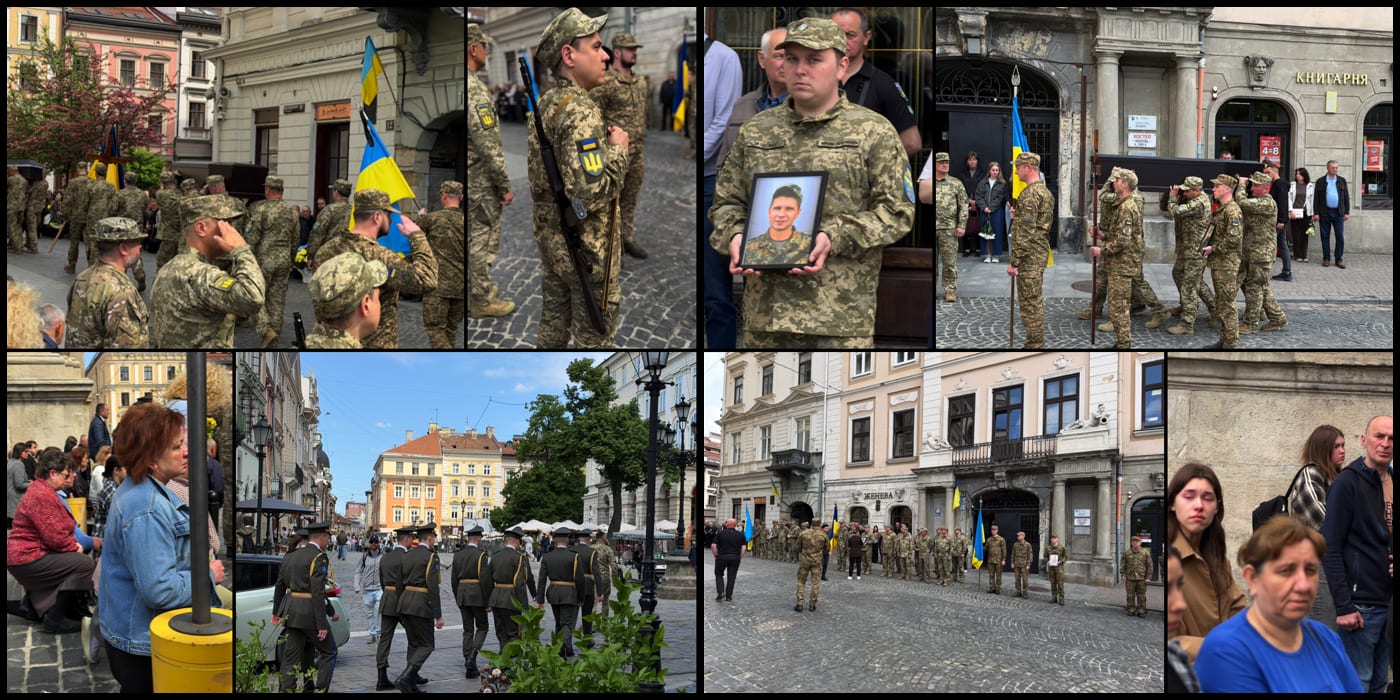
I was completely unprepared. My shorts and a dumb t-shirt felt woefully inappropriate. I knelt too, but only for as long as my feeble, bare knee could manage. But what really caught me out was noticing one woman in the crowd who was perhaps roughly the same age as our children. She was not holding flowers and in fact left to get on with her day once the procession began to enter the church. So most likely she did not know the fallen soldiers personally, but she had already lost loved ones. She was fighting back tears the whole time. And they were contagious.
I was filled with such grief simply from witnessing this simple human act of commemoration and committal. These are not my people; but what this war represents (to my mind) makes them my people. Their experiences are not mine; but the resilience in enduring this national trauma (a word I do not use lightly) are nothing short of inspiring. And I’ve been struggling to hold back the tears all day now.
No. This, most emphatically, is not normal.