
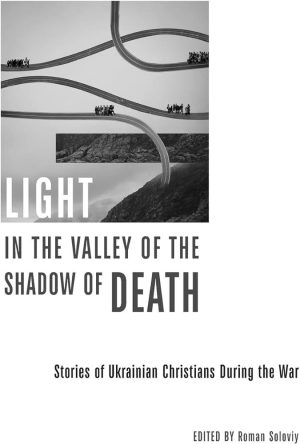
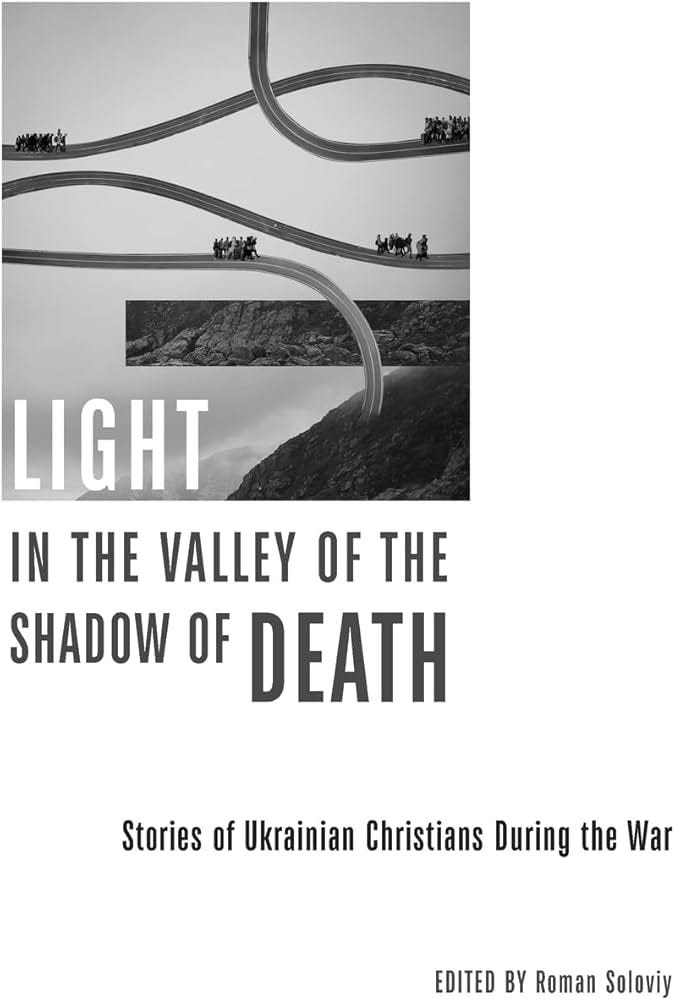
I received my copy of this superb book soon after publication late last year. But it has taken me until now both to read it all and then to process it all. A myriad thoughts have spun round my head. To say this is a difficult read will sound like criticism, but it really isn’t. Light in the Valley of the Shadow of Death is a book about reality: the reality of invasion and war. For the vast majority of contemporary western people is utterly alien. War is the stuff of shoot-em-up VR games or action movies or history books. But for all those involved in this anthology, war is lived reality. Taras Dyatlik’s powerful diary entries from the very first days give historical context.
What’s happening right now has happened before, on 1 September 1939 and 22 June 1941. We are here in Ukraine, not in “a situation,” but in the middle of a brutal full-scale invasion happening to a country of 40 million people, and all this is in the twenty-first century. We didn’t invite this war. Kremlin and Putin brought it to Ukraine. This is not “a perspective.” (p30)
Inescapable, horrific, lethal.
Walking In Others’ Shoes
That is enough to put most gentle readers off, of course. For we know all too well that ‘Humankind cannot bear very much reality.’ But it is vital to read books like this. Especially in a world as unstable as it currently is. It is the responsible path since we all have much to learn from the Ukrainian experience. Here is Pavlo Horbunov:
I get very emotional when I think about how many people are living in an illusion – whether it’s the idea of optimistic humanism, the prosperity gospel, the comfortable gospel, or simply the principle of “not my concern” – and fail to recognize the existence of war, hunger, and death.
Instead, they are sheltered in a rose-tinted bubble, deaf and blind to human suffering and the shattering concept of evil. (p101)
I should say that I have grown to love and admire the country in equal measure since my first visit in 2016. I’m writing this now as I prepare for my third trip since the start of the ‘full-scale war’ (as Ukrainians put it, to remind us that the conflict actually started with the annexation of Crimea in 2014). It is impossible to grasp the depths of others’ trauma (not least when it has become both catastrophic and chronic ). But because these writers pull no punches in articulating their experiences, perspectives and hopes, we can at least begin to imagine what it is to walk in their shoes.
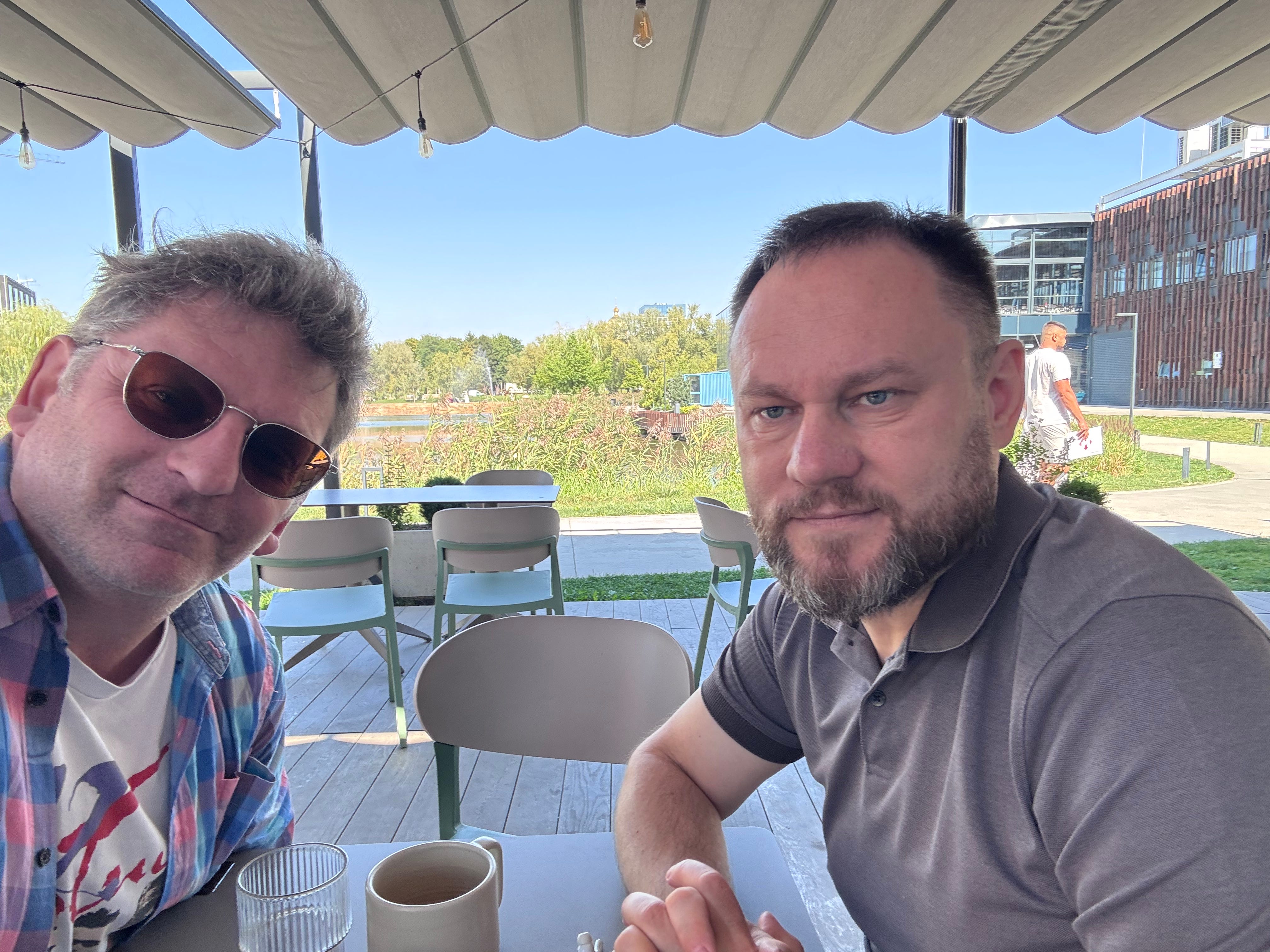
That said, I had to put the book down at various points simply because tears blurred my vision. Yet despite that, the accumulative effect was utterly inspiring. The fact that each contributor is able to stare down these realities, and even on occasion to find purpose and hope in the midst of them, is extraordinary. As Oleksandr Geychenko writes:
At that moment, I knew God was, and still is, present in the midst of our people’s sufferings. He shares the pain and sorrow of all who have been impacted by this cruel and inhumane war. I took the bread, and I knew that I was part of the body of Christ scattered across my war torn country, “If one part suffers, every part suffers with it; if one part is honoured, every part rejoices with it. Now you are the body of Christ, and each one of you is a part of it” (1 Cor 12:26-27). (p60)
This is not escapism. This is not wishful thinking. This is hard, gritty, resilient, tempered and refined trust in God.
War From All Angles
The twelve pieces were written around the two-year point after Russia’s unprovoked arrival in February 2022. We are now, of course, well into the fifth year.
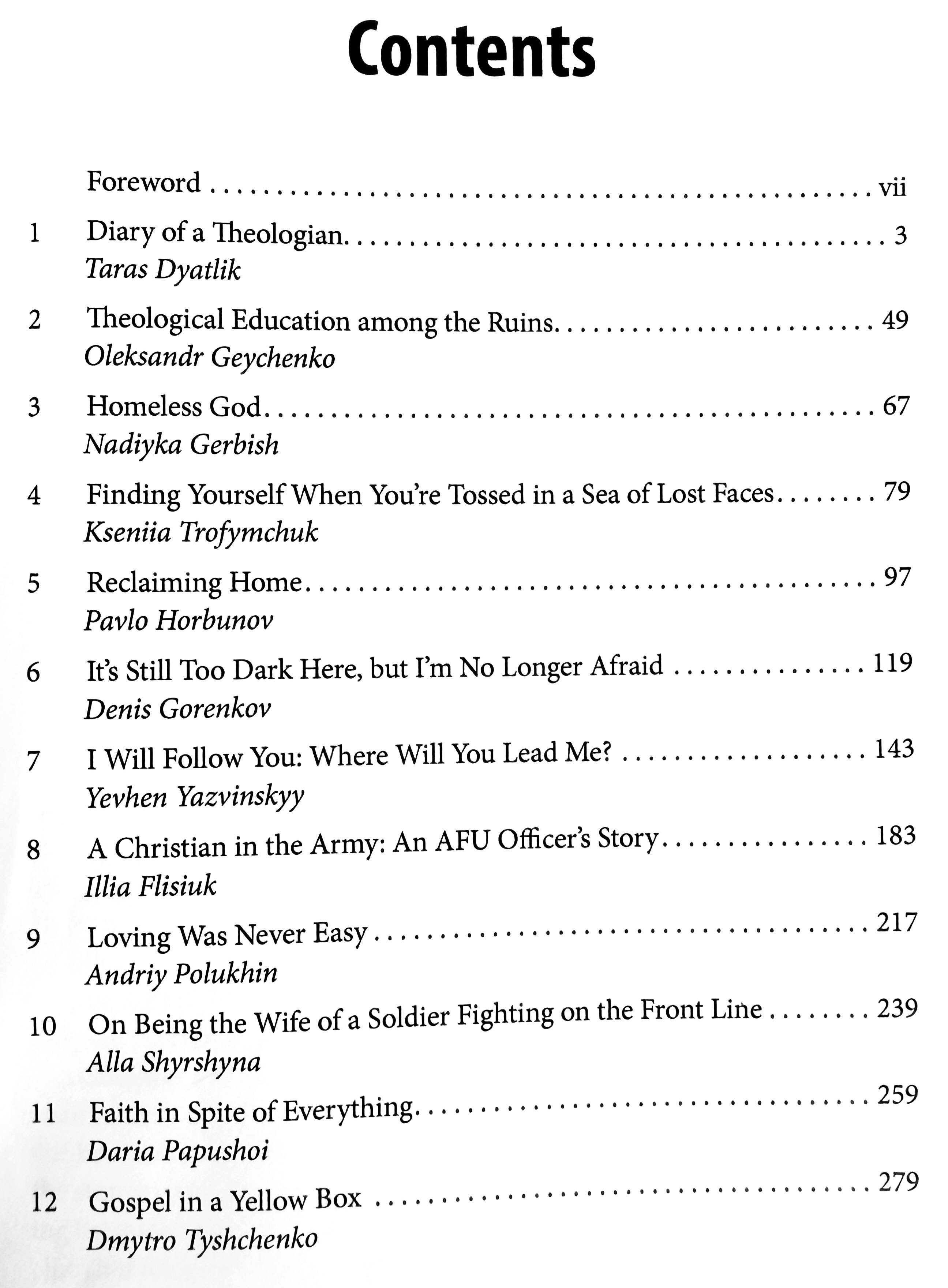
The sum total of these remarkable parts is astonishing. Each is powerful by itself. Each provoked the same thought: ‘now that was a standout chapter’. But when twelve chapters all stand out you know you have something special in your hands. That this war-time anthology was assembled during a war is testament to Roman Soloviy’s editorial abilities, since managing disparate writers for such books is like herding cats at the best of times. And these are the worst of times. Not only that, there is its range. From deep theological reflection to raw testimony, we are immersed into the lives of men and women, the front line and domestic fronts, some professors, a chaplain, a foot-soldier, an officer, the exiled, a grieving widow and new mother, and more. Every single chapter provokes thought or new insight. Trying to convey a sense of that for a review is impossible.
Let me just offer one or two pearls that stuck me. I loved this paragraph from Kseniia Trofymchuk, not least because Ι’ve known a number of Ksenijas/Kseniias over the years. I’d never even stopped to considered the simple but obvious Greek derivation! I’ mean, obvs! It has piquancy, however, by the fact that she was one of the millions grappling for stability having left Ukraine in those first days.
My parents had always told me that my name was a prophetic one because my mother had dreamed that she would give birth to a girl named Ksenia! have always been proud of my name – up until the point of becoming a refu gee. This reminds me of the way names are treated in the Bible, how a name becomes an integral part of a person’s identity. My name does indeed come from the Greek word ξένoς (xenos), which means “stranger” or “guest”, and ξενία (xenia) means “hospitality towards a stranger.” A name is the first gift given to someone as they are brought into this world. Why wouldn’t such a gift be welcomed? But perhaps it takes a journey or two – from Israel to Moab and back again – to transform your harrowing experience into a practice of sincere hospitality. (p88)
It is a commonplace that most extreme circumstances provoke the darkest humour. I was glad to find it here too. Here is Pavlo again, recounting how bright yellow school buses were used to ferry troops to the frontline.
We used to joke with each other that the Russians on the other side must surely be stunned by an unknown type of troops travelling to the contact line in brightly coloured public transport and terrified by such boldness. In reality, it was utter madness and lack of competence. (p103)
But most of this is far from a laughing matter. This passage from Yevhen Yazhinskyy is wedged in my memory, visceral in its honesty.
Fear. It’s so sticky, so contagious. Paralyzing.
Everyone – big and small, young and old, weak and strong, brave and faint – feels fear. Christians, too, feel fear. However, what matters is how this fear affects us and what it reveals about us. It is like a storm that rages against a house built on a rock or on sand and, in doing so, uncovers our truest founda-tions. It exposes things we haven’t considered or realized before. (p150)
And again:
What I struggled with most was admitting honestly that I didn’t want to die. I grew up in a culture where, for a long time, it was thought that the end goal of a believer is to go to heaven and that this is the greatest good and the main meaning of life. That’s what we should want and strive for. We live to get to heaven. Christ is waiting for us there, and he will wipe away every tear from our eyes. But walking around the partially encircled city of Sievierodonetsk, taking cover from shelling, I realised that I really wanted to live. I was so ashamed to admit this to myself or to others, and it was even harder to admit it to God.There wasn’t a single believer around to share this with, which made it even more agonising. (p153)
Finally, this from Andriy Polukhin. One of countless reminders that this is not fiction and that in war there are many endings that are far from happy in this life.
The hardest part was the farewell to Ihor Zinych. The funeral was held at a local Baptist church I’d visited before. As I approached the coffin, his brother saw me, quietly took my hand, and held it until it was my turn to deliver the eulogy. We still keep in touch. Ihor’s death showed me that soldiers sacrifice themselves for others and, in doing so, embody the sacrifice of Christ. They prove their love for their families, their people, and their country right up was to their dying breath. (p228)
This reminded me of that great G. K. Chesterton insight that, ‘The true soldier fights not because he hates what is in front of him, but because he loves what is behind him.’ This is not to deny that the book’s contributors feel hatred sometimes or even often. For war is hateful and the acts of war are hateful. It is not for us in our centrally heated and drone-free neighbourhoods to condemn or pontificate. Instead, I admired each writer for avoiding all pretence and super-spirituality as they battle to live faithfully. That right there is a vital lesson for all believers in a crazy world.
Do not give up hope
There is far more to include than I have space for. So read it all for yourself!
Of course, no book is perfect and so this book cannot be perfect. But I honestly cannot think of many others that have affected me so much. I don’t think it is simply because I know the country a bit. My sense is that despite each chapter being prompted by a very specific and terrible sequence of events, it is all relevant in a thousand ways to the faith journey all believers must walk (war or no war). And that is why I’m sure I’ll return to parts of this book often.
I’ll close with this passage from Nadiyka Gerbish’s chapter:
Phan Thi Kim Phuc wrote the foreword to this edition [a photo book titled The Crown of Creation: Masterpieces and Their Stories from the Museum of Humanity]. She is the woman in the iconic photograph taken in 1972 by Nick Ut to expose the horrors of the Vietnam War to the world. The picture shows Kim Phuc as a nine-year-old girl – naked, barefoot, and burned – with other children and soldiers, running away from the flames that destroyed her village, Trang Bang, after it was hit by a napalm bomb. Nick Ut took that photo and later saved that girl’s life. Today, Kim Phuc is a grandmother. She lives with her husband in Canada and runs a non-profit that supports victims of war. In 2022, she travelled the world carrying a Ukrainian flag that bore the words “Do not give up hope” in bold black ink. (p70)
Enough said.
[For transparency’s sake, I should say that I worked in different capacities for another of the Langham Partnership programmes (Langham Preaching) for 20+ years, and I know a few of the contributors including Roman the editor.]