I read this over New Year on the strong recommendation from Johnny Baker, and have been mulling on it ever since (and have already quoted from it a number of times). I’m sceptical when a new book gets described as a ‘masterpiece’ (as Cory Doctorow from Boing Boing does on the cover) – but while that is surely hyperbole, there’s no doubting the importance of this book.
For those who’ve seen Aleks Krotoski’s excellent recent BBC2 series, The Virtual Revolution, (and if you didn’t, the dedicated website has tons of good stuff), you’ll be familiar with some of this. But Clay Shirky in this book does for the contemporary web-user what a thermometer does for the frog in gradually boiling water. Our eyes are opened to our environment. I found myself constantly recognising personal experience of web use in what he described; but I’d never been able to analyse it, let alone articulate it, so well. His attention ranges from sites dedicated to finding someone’s lost phone, to political campaigns (although this was written a bit too early for Obama’s campaign), from sharing event photos on Flickr to coalitions protesting child abuse in the Catholic church, from the wonders of grinning flash mobs to the phenomenon that is wikipedia. None of these would be possible without the internet – and they have radically changed, for better and worse, how we find and distribute information, as well as how we relate socially. This is all a given – the issue is how we adjust to this new world.
I’m not going to review the book here – although I thoroughly enjoyed it and learned a lot. I merely want to highlight a few of the more important points (as they seem to me) …
Inventions and Extinctions
It has become rather a cliché to compare the web’s arrival to the affect of printing on Renaissance Europe. Yet the parallels are many, and often helpful, not least because it took decades before the press’s full impact could be seen and adjusted to. I was very struck by the example of the Abbot of Sponheim,one Johannes Trithemius, who wrote a paper in praise of scribes in 1492 – almost 50 years after the arrival of the press. Whereas for centuries, scribes were integral to the preservation and dissemination of information, despite their laborious work, the press rendered them unnecessary overnight. So the Abbot has to defend the art:
Scribes existed to increase the spread of the written word, but when a better, non-scribal way of accomplishing the same task came along, the Abbot of Sponheim stepped in to argue that preserving the scribes’ way of life was more important than fulfilling their mission by non-scribal means. (p69)
But most tellingly, how does the Abbot spread his ideas? In print! As Shirky notes,
the content of the Abbot’s book praised the scribes, while its printed formed damned them; the medium undermined the message. (p68)
The affect of this new technology was double-edged. As he goes on:
The comparison with the printing press doesn’t suggest that we are entering a bright new future – for a hundred years after it started, the printing press broke more things than it fixed, plunging Europe into a period of intellectual and political chaos that ended only in the 1600s. (p73)
The profession of calligrapher now survives as a purely decorative art; we make a distinction between the general ability to write and the professional ability to write in a calligraphic hand, just as we do between the general ability to drive and the professional ability to drive a race car. That is what is happening today, not just to newspapers or to media in general, but to the global society. (p79)
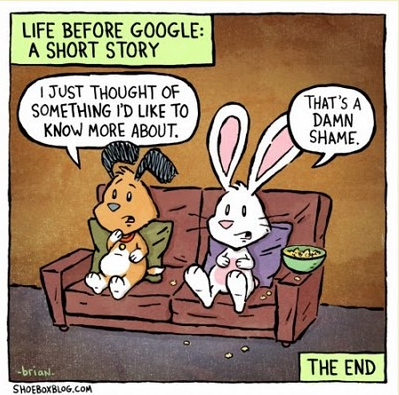
By Brian at Shoeboxblog
So what are these global effects?
The ascendancy of the amateur
One of the biggest shifts that Shirky outlines is emergence of the amateur over and above the expert. In many professions, it is now practically impossible to preserve occupational selectivity and authority. An obvious illustration is that of newspapers. “The future presented by the internet is the mass amateurization of publishing and a switch from ‘Why publish this?’ to ‘why not?’” (p60)
Of course that leads to an overwhelming surge of information – it’s impossible to wade through it all (hence the genius and all-pervasive influence of Google). Yet an ironic outcome is that, far from being a failure or a flaw, this increases risk-taking. Publishing (an incredibly expensive activity) has been supplanted:
… the respective costs of filtering versus publishing have reversed. In the traditional world, the cost of publishing anything creates not just an incentive but a requirement to filter the good from the bad in advance. In the open source world, trying something is often cheaper than making a formal decision about whether to try it. (p249)
The principle has been applied to Open Source programme (e.g. Linux) and encyclopedia-writing as in Wikipedia (incidentally, I’d always assumed that the name was a spin on slang ‘wicked’ meaning cool – but ‘wiki’ is in fact Hawaiian for ‘quick’ p111). Organically evolved from 60s hippy idealism in West Coast America, these represent the heart of what many hoped the internet would be at its best. Collaborative, social, generous and above all free. A far cry from the profit motives of a Bill Gates or Steve Jobs – clearly shown in the 2nd episode of Aleks Krotoski’s BBC series. Of course, human nature is such that optimism isn’t enough to make things work, as the founder of eBay discovered, and as I quoted from Shirky a few weeks back.
But I love the simple fact that Wikipedia works. Many decry it as the end of civilisation as we know it – but it is amazing how authoritative it has become (not to mention how up to the minute). And that is not wishful thinking – experts in their fields frequently contribute to it and correct those who get things wrong. And it’s all done when people feel like it and for free! Shirky gets a hole in one on this point:
We are used to a world where little things happen for love and big things happen for money. Love motivates people to bake a cake and money motivates people to make an encyclopaedia.Now, though, we can do big things for love. (p104)
So he internet means that everyone can have a go. Goliaths are perhaps more vulnerable to Davids than ever before. This is both fantastic (it is now much harder than it has ever been for the corrupt and despotic to control others); and terrifying (for, in the hands of the malicious and destructive, such technology is potentially devastating).
Social as never before
As a sociologist, Shirky is interested in how people interact. “Communications tools don’t get socially interesting until they get technologically boring.” (p105) And what the web has enabled unbelievable interaction:
…social tools don’t create collective action – they merely remove obstacles to it. Those obstacles have been so significant and pervasive, however, that as they are being removed, the world is becoming a different place. This is why so many of the significant social changes are based not on the fanciest, newest bit of technology but on simple, easy-to-use tools like email, mobile phones, and websites, because those are the tools most people have access to and, critically, are comfortable using in their daily lives. Revolution doesn’t happen when society adopts new technologies – it happens when society adopts new behaviours. (p159)
This means that it is possible for people to connect with other like-minded people like never before. A site like MeetUp is a case in point. I’ve found this in extraordinary ways myself – people have contacted me through this blog on the basis of the most bizarre searches (and vice-versa) – and yet that has led to very fruitful interaction and conversations. A powerful example of how this can make an exponential difference is Shirky’s comparison between the protests against the coverup of Catholic priests’ child abuse in the 1992 and 2002. Just 10 years changed everything. In 1992, the authorities were able to neutralise the threat. By 2002, the web had created the means by which people could do 2 key things for the first time (p143-148):
people across a diocese, and indeed the USA, could share information
people across a diocese, and beyond, could coordinate efforts
Again, this is double-edged – but its power mustn’t be underestimated or ignored. So in the repressive world of Belorussia (anticipating some of the extraordinary events that happened online in Iran last year), amazing things have happened:
Minsk ice-cream eating 'criminals'
…the idea [of the Minsk flash mob of May 2006] was simply that people would show up in Oktyabrskaya Square and eat ice cream. The results were one part ridiculous and three parts depressing; police were waiting in the square and hauled away several of the ice cream eaters, all while being documented in the now-standard pattern as other participants took digital pictures and uploaded them to Flickr, LifeJournal and other online outlets… Images of a repressive Belarus thus spread far beyond the borders of Minsk. Nothing says “police state” like detaining kids for eating ice cream.
The ice cream incident was not an isolated incident. Flash mobs were held to protest the banning of the Belarussian Writers Union (‘show up at the Supreme Court, read books by the writers of the organisation’) and the closing of the newspaper Nasha Niva on the day it was to be shut down (‘Gather in Oktyabrskaya, reading copies of Nasha Niva’). In the fall perhaps the simplest flash mob ever proposed took place: ‘Walk around Oktyabrskaya smiling at one another.’ This action produced the same reaction from the state; attendees reported that the police were using the presence of a pocketknife to try one of the smilers with weapons possession. (p166-7)
Avoiding the Canute syndrome
I could go on. But I’ll simply recommend reading it – or if you don’t have time, watch Shirky’s TED lecture from 2005, added below.
But I’ve been reading this, and others like Shane Hipps’ Flickering Pixels (and am about to read Jesse Rice’s Church of Facebook, Ken Auletta’s Googled and Chris Anderson’s Free) because the web profoundly impacts how we function as the church. But there’s also a pressing issue in that I’m in the process of working on a website ‘philosophy’ for the All Souls site as we undergo a major reevaluation and reconstruction. I may put that up here if it seems appropriate. But let me finish where Shirky does – because this makes the point forcefully that we can’t Canute-like ignore or stop the waves – we need to learn how to live in a world of waves. He uses the illustration of Manutius, a printer in Venice who saw the possibilities of printing by creating the octavo size of page – which meant that for the first time, books could be carried in the pocket.
One lesson from Manutius’s life is that the future belongs to those who take the present for granted…
Like Aldus Manutius, young people are taking better advantage of social tools, extending their capabilities in ways that violate old models, not because they know more useful things than we do, but because they know fewer useful things than we do. I’m old enough to know a lot of things, just from life experience. I know that newspapers are where you get your political news and how you look for a job. I know that music comes from stores. I know that if you want to have a conversation with someone, you call them on the phone. I know that complicated things like software or encyclopaedias have to be created by professionals. In the last fifteen years, I’ve had to unlearn every one of those things and a million others, because those things have stopped being true. (p319-320)

 I read this over New Year on the strong recommendation from Johnny Baker, and have been mulling on it ever since (and have already quoted from it a number of times). I’m sceptical when a new book gets described as a ‘masterpiece’ (as Cory Doctorow from Boing Boing does on the cover) – but while that is surely hyperbole, there’s no doubting the importance of this book.

 But I’ve been reading this, and others like Shane Hipps’ Flickering Pixels (and am about to read Jesse Rice’s Church of Facebook, Ken Auletta’s Googled and Chris Anderson’s Free) because the web profoundly impacts how we function as the church. But there’s also a pressing issue in that I’m in the process of working on a website ‘philosophy’ for the All Souls site as we undergo a major reevaluation and reconstruction. I may put that up here if it seems appropriate. But let me finish where Shirky does – because this makes the point forcefully that we can’t Canute-like ignore or stop the waves – we need to learn how to live in a world of waves. He uses the illustration of Manutius, a printer in Venice who saw the possibilities of printing by creating the octavo size of page – which meant that for the first time, books could be carried in the pocket.
2 responses
This is really good. Please pray for us.