
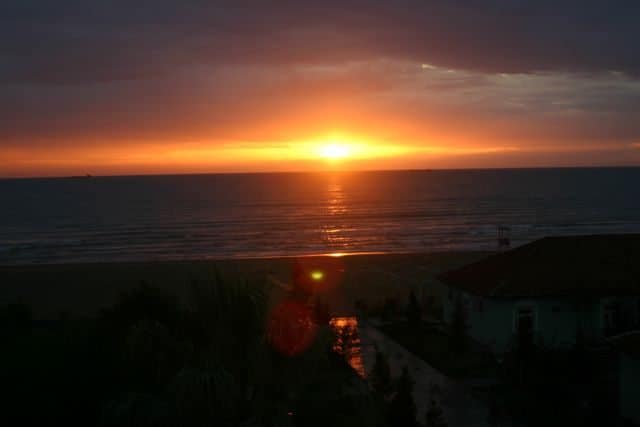
I took this on Monday evening from the conference centre just along the coast from Durrës, Albania, where I was involved with the latest Langham Partnership conference with Chris Wright. And as Chris reminded us, it is highly plausible that the Apostle Paul visited Durrës – perhaps he even went for a sundowner stroll along this beach…?
In Romans 15, Paul mentions that he preached all the way from Jerusalem to Illyricum (which is ancient Albania). In Acts 20, we find that Paul travelled through Greece. As FF Bruce points out in his Acts commentary, we have no idea how long Paul travelled or where. His ministry was certainly extensive and ambitious, constantly moving on to the next place. After all, we do know that he had set his sights on Spain and perhaps beyond, as goals after visiting Rome.
 We also know that his good chum Titus visited Dalmatia, just up the coast a bit from Albania, in what is now Croatia. And if we are right in thinking that he packed Titus off there, as scholars Bruce and Duncan suggest, then it is more than plausible that their parting point was Durrës – it marked the western end of the great Roman Road, the Egnatian Way. (This map shows Dyrrhachium, the ancient name for Durrës, in the top left)
Now in one sense, it doesn’t matter one jot who was there first and when (cf Paul’s attitude to those he did or didn’t baptise in Corinth). What does seem to be true, though, is that even by as early as AD58, there were 70 Christian families living in Durrës. Amazing when you think that Albania endured one of the toughest atheistic regimes in recent history. All this served to remind me yet again of the fluidity of empires. For the history of Eastern Europe has been nothing if not turbulent, as my last few days made clear.
After Communism 1 – Czech Republic
 Our brief trip started last Friday with a weekend in Prague for the Langham European Regional Council – it drew a fascinating group of men and women together to discuss the development of Langham’s programmes across the continent. Our host was IBTS (The International Baptist Theological Seminary) – which since 1994 has been located in a former castle in Jenerálka (left), in North-west Prague. Prague has to be one of my all time favourite places on earth anyway – but I was stunned by the recent history of Jenerálka Castle (described in fascinating booklet by Petra Veselá).
- 1939-1945 – THE NAZIS: The castle functioned as the HQ for the Gestapo’s activities in Czechoslovakia. During this time it also housed around 50 orphans of Czech political leaders killed by the Nazis.
- 1953-1990 – THE COMMUNISTS: The castle was then occupied by a Research Institution which worked closely with the Czech equivalent of the KGB, developing military and espionage equipment, and the State Police had offices in the castle buildings. It was discovered in 2000 that the castle had been also base for a major operation to capture people who attempted to escape to the west across the border into Germany. Many were beaten and tortured and some were shot within these very walls.
- 1997-? – THE CHRISTIANS: The castle was bought in 1994 by the European Baptist Federation, who had wanted to move their seminary from Switzerland to somewhere more accessible for Eastern Europeans. And now it is a truly international community, seeking to train people to the highest level for Christian ministry of all sorts.
It is clear then that NOTHING is ever set in stone in human history, however monolithic and unassailable a particular regime seems at a particular moment.
After Communism 2 – Albania
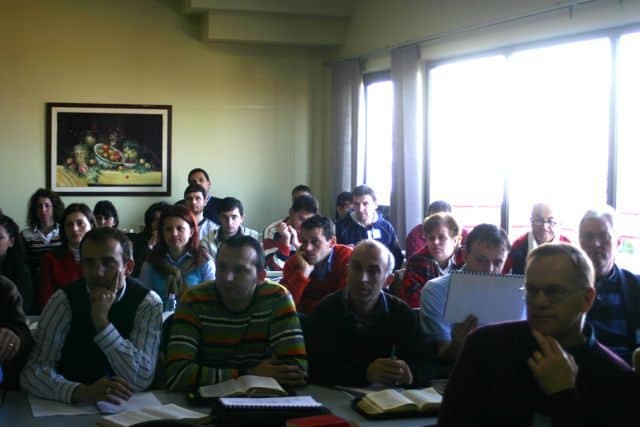 It is easy to forget that Albania was one of the first countries in Europe to have a Christian church. But as alluded to the last time I was here, things are very different these days. I can remember people talking about the country when I was at university, and then it seemed to be a byword for closed and oppressive regimes. The thought that 20 years later, I would be able to saunter in quite freely with a suitcase loaded with Christian material, on more than one occasion to boot, was unthinkable. The church is growing fast, in this extraordinarily beautiful part of the world. To have a gathering like the one in this picture (I can assure you that everyone was happier about being there than they look!) would have been incredible dangerous.
 Incidentally, to get a sense of the vortex of trying to work out what is reality under a communist regime, read Albanian writer Ismail Kadare‘s chilling but brilliant book, The Successor, obviously based on the dictatorship of Enver Hoxha. But even here, there is a fine twist of fate (not that I believe in fate, of course). For today, there is a church that now meets every week in Hoxha’s house in Tirana, of which one of the leaders is a member of the Langham Albania conference committee.
I’m not naive about this – history is full of fluctuations – after all, many Christian buildings are used for very different purposes as well, as I mentioned last June. The point I’m making is simple. Things change – the status quo never lasts. Shake that up with the concept that nothing is impossible with God, and you begin to find the grounds for confidence and hope for the future.
The statues of Lenin, Stalin, Hitler, Hoxha and more recently Saddam no longer stand. Remember Shelley’s great poem:
OZYMANDIAS
I met a traveller from an antique land
Who said: Two vast and trunkless legs of stone
Stand in the desert. Near them on the sand,
Half sunk, a shatter’d visage lies, whose frown
And wrinkled lip and sneer of cold command
Tell that its sculptor well those passions read
Which yet survive, stamp’d on these lifeless things,
The hand that mock’d them and the heart that fed.
And on the pedestal these words appear:
“My name is Ozymandias, king of kings:
Look on my works, ye Mighty, and despair!”
Nothing beside remains: round the decay
Of that colossal wreck, boundless and bare,
The lone and level sands stretch far away

Son of man, say to the ruler of Tyre, ‘This is what the Sovereign LORD says:
” ‘In the pride of your heart
you say, “I am a god;
I sit on the throne of a god
in the heart of the seas.”
But you are a man and not a god,
though you thinkyou are as wise as a god.