
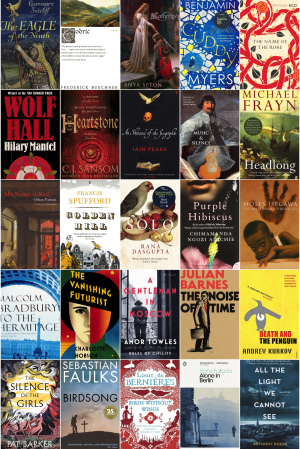
Apparently, men don’t really read fiction. Which seems totally nuts to me. I just don’t get that at all. What’s not to love? But then, I’ve been (un?)reliably informed that I’m odd. More fool everybody else, I say.
So for my next 25, and because I’m hubristically attempting to write my own, I thought I’d gather my favourite historical novels, in rough chronological order (in terms of setting rather than writing); although to be fair, this rather breaks down by the end!
One rule I’ve set myself is that no author can appear more than once (even though one or two on this list warrant several entries).
** = my top 3!!
5 books: Out of the dim and distant mists…
-
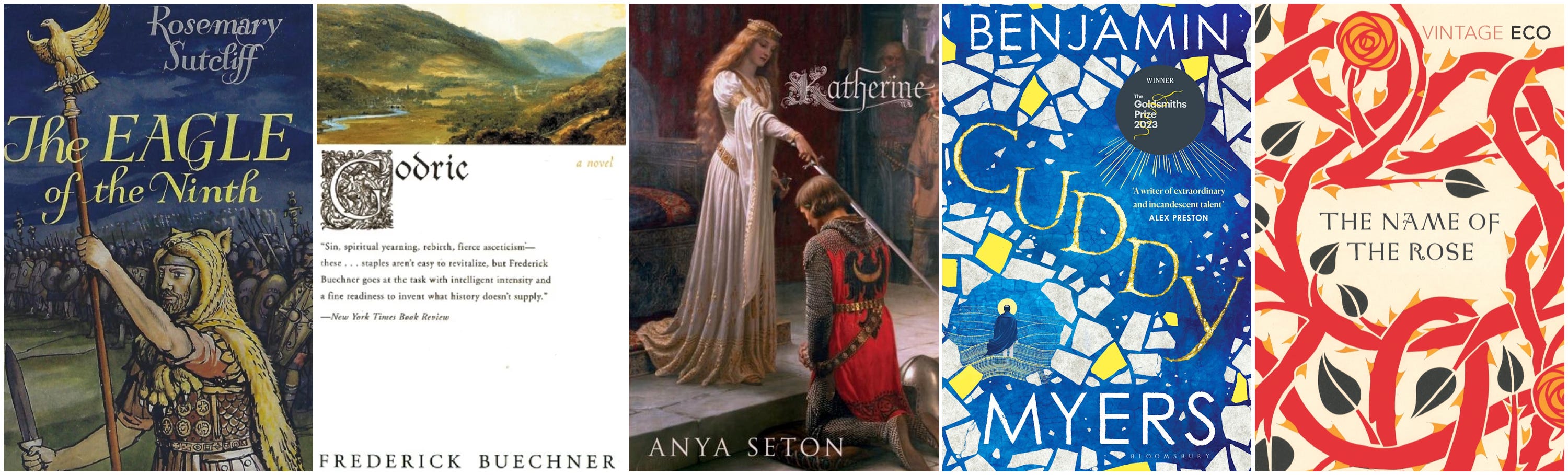
Rosemary Sutcliff’s The Eagle of the Ninth (Beyond Hadrian’s Wall): I suppose this is a book for young adults, but so what? It’s a brilliant and pacey evocation of Roman Britain, imagining how the 9th Legion’s standard might be recovered from the barbaric Pictish tribes north of the wall as a way of salvaging some Roman honour. Just love it. Ignore the movie.
-
Frederick Buechner’s Godric (County Durham): A masterpiece about Godric, a real mediaeval hermit and ex-Crusader, who harbours deep secrets and guilt and who tries to fob off the innocent monk Gerald sent to write his hagiography. Stunning writing and some real shocks, it is a powerful meditation on guilt, regret and facades.
-
Anya Seton’s Katherine (London and Spain): another story based on reality, this is the shocking story of the Dutch Katherine Swynford (Geoffrey Chaucer’s sister-in-law as it happens). She was the beloved lady-in-waiting to the wife of prince John of Gaunt (Duke of Lancaster). To cut a long story short, Katherine will become his 3rd wife. And all subsequent English monarchs are descended from them through their oldest surviving son, Henry IV. This is a beautifully researched but never heavy novel that is a full mediaeval immersion experience. (Oh, and for what it’s worth (not v much), our family can trace back to John and Kate too!)
-
Benjamin Myers’ Cuddy (Durham over the centuries): Cuddy was the nickname of St Cuthbert who ended up being buried in Durham Cathedral. But this ingenious novel traces different story lines in four different eras: Viking attacks on Lindisfarne, mediaeval cathedral builders, Regency-era academic scepticism, contemporary period of austerity. Such a clever conceit, but it is always affecting, with real stop-you-in-your tracks emotional punch.
-
**Umberto Eco’s The Name of the Rose (Italy): Eco was the polymath’s polymath with a personal library to die for. But this page-turner of mediaeval whodunnit made him a household name (especially once Sean Connery inhabited the protagonist, William of Baskerville). But Eco effortlessly incorporates a fascinating philosophical puzzle, intricate knowledge of the ecclesiastical turmoil during the Avignon papacy (it even ended up on Oxford friends’ Mediaeval History reading lists), all while paying homage to Sherlock Holmes (Baskerville anyone?). If I wasn’t restricted to one per author, I’d also have included Eco’s Foucault’s Pendulum here!
5 books: Into the Renaissance…
-
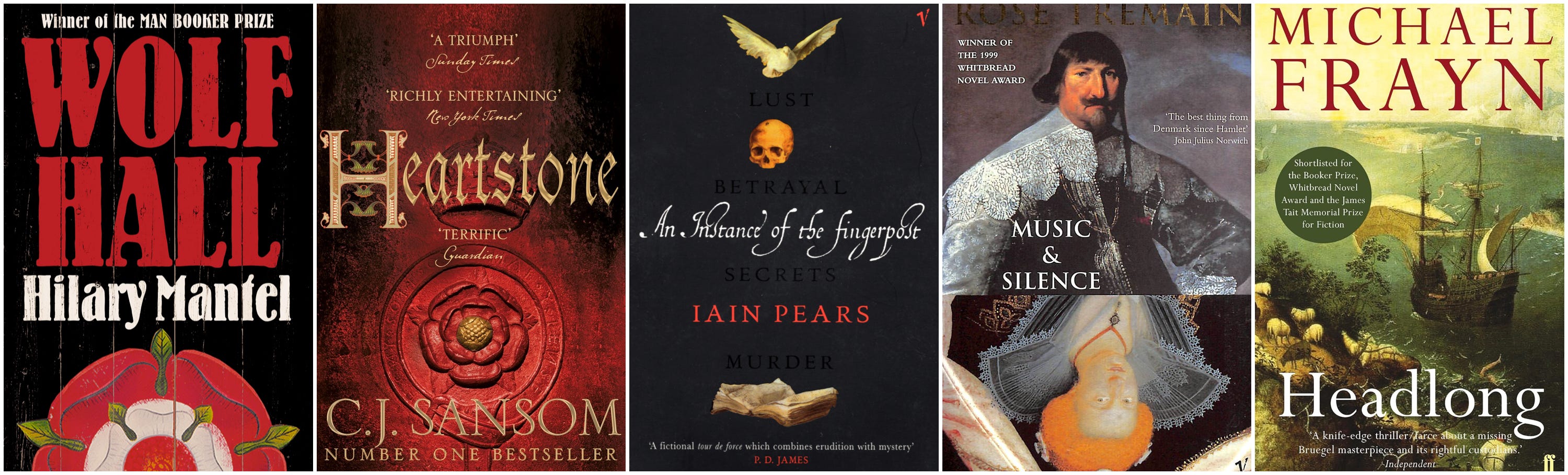
Hilary Mantel’s Wolf Hall (Henry VIII’s England): I read one or two others by Mantel which didn’t grab me, despite being super writing. But this, the first of the Thomas Cromwell trilogy was astonishing. She takes a notorious and (by common consensus) villainous actor in English Tudor history and conjures him into a deeply sympathetic and compelling character.
-
C. J. Sansom’s Heartstone (Henry VIII in Portsmouth): Can’t remember who introduced me to Shardlake, the hunchback lawyer-cum-sleuth, but I have hungrily anticipated each book in the series that began with Dissolution (exploring at some of the havoc wreaked by Cromwell at the king’s behest from below). This is the fifth, and much that I loved all of them (though the final Tombland could certainly have done with a little more editorial rigour!), this is a great romp because it features the sinking of Henry’s great flagship the Mary Rose in Portsmouth harbour. Brilliant.
-
**Iain Pears’ An Instance of the Fingerpost (Restoration Oxford): Now here is the true MASTERPIECE. This is my favourite historical novel of all time, hands down. Set in the royalist city of Oxford soon after the restoration of the Monarchy, Pears constructs four different narratives of the same events, each one adding a completely new but compatible spin. Breathtaking in its invention, its atmosphere and detail, its characters and historical context. Just WOW!
-
Rose Tremain’s Music and Silence (Denmark): We’re in the royal Danish court, but not Hamlet’s. This is the story of the relationship between the court lutenist Peter Claire and Emilia, a servant of Christian IV’s second queen just as the king is divorcing her. We’re in the 1630s, a period about which I knew not a thing. As one might expect, court politics was fraught the reader is propelled into its absurdities and jeopardy. As the title suggests, this is a book of counterpoints and opposites.
-
Michael Frayn’s Headlong (Netherlands): If you’ve not discovered Frayn, you must. One of the funniest men alive (at time of writing he is 92). You might know him from his weepingly funny play and film Noises Off. This straddles the present and the time of the Dutch painter Pieter Bruegel the Elder (c1525-1559) who lived under Spanish rule. But in true farce style, the main character thinks he’s discovered a missing Bruegel but his plans come to naught as everything that could go wrong, implausibly and hilariously, does.
5 books: Heading further afield…
-
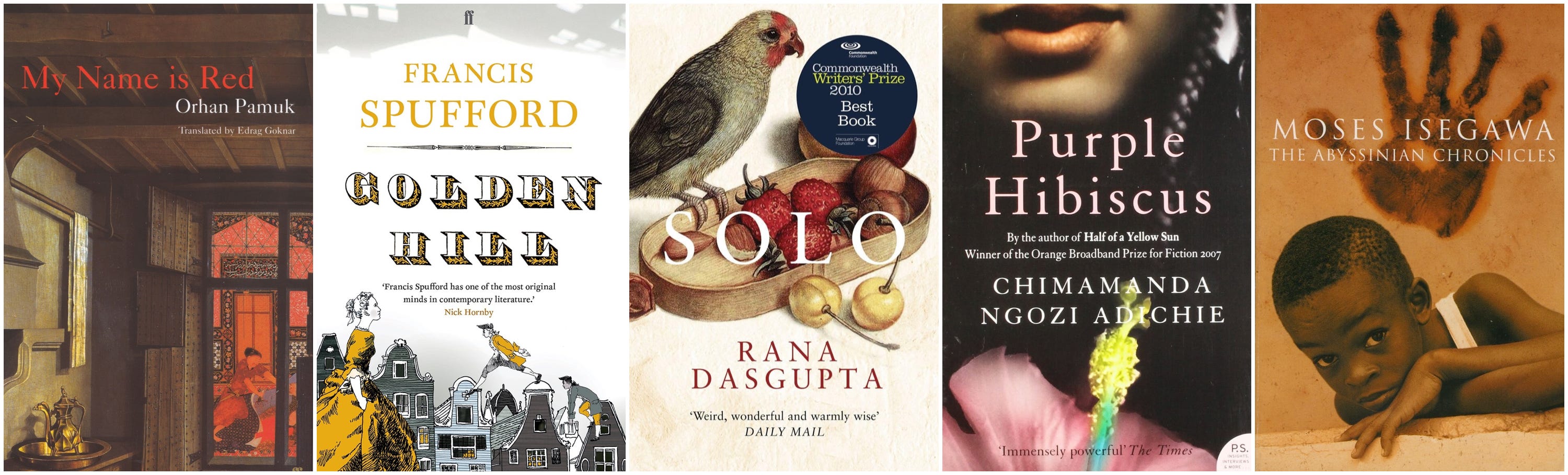
Orhan Pamuk’s My Name Is Red (Ottoman Empire): This is strange but utterly compelling: 21 narrators tell the story of a murdered artist from the Sultan’s workshop of miniaturists (including the victim at one point, and at another the colour red!). An undergirding theme behind the crime is the fraught relationship the Ottoman world (not to mention modern Türkiye) has with the West, using aesthetic style and philosophy as a lens. Not so much a whodunnit (the murderer is another narrator) as a whydunnit. A superb immersion into an alien world.
-
**Francis Spufford’s Golden Hill (British New York): oft repeated, the greatest eighteenth century novel written since the eighteenth century (ie in 2016). The intonation and language of colonial America is nailed as the stranger Mr Smith appears in New York with a demand note for a vast amount (£1000). It takes several weeks to get messages across the Atlantic so should it be honoured before verification arrives or not; and what does Mr Smith want this sum for? Read it to discover! It’s gripping, hilarious, moving and evocative with an utterly brilliant denouement.
-
Rana Dasgupta’s Solo (Sofia, Bulgaria): Can’t for the life of me remember why I picked this up but it’s stuck with me. A blind Bulgarian chemist turns 100 and reflects on his fairly unremarkable twentieth century life while dreaming of what the 21st century will hold. He has daddy issues that still affect him and he is haunted by the question of how to measure and weigh a life. For more, see the review I wrote 15 years ago.
-
Chimamanda Ngozi Adichie’s Purple Hibiscus (Nigeria during a coup): I read this because our daughter raved about it and I quickly realised why. Adichie’s a wonderful writer who perfectly captures times and places. A family’s dynamics evoke many of Africa’s own, in particular the constant need to grapple with colonialism and outside influences as well as the religious and cultural tension between tradition and modernity. It is emotionally fraught with the horrors and legacy of a husband’s abuses exposed with empathy rather than prurience.
-
Moses Isegawa’s The Abyssinian Chronicles (Uganda): I read this soon after we arrived to live in Uganda in 2001 (it came out in 1998). There are parallels with Salmon Rushdie’s and Gabriel Garcia Marquez’s writing on India and Colombia respectively since this book begins the night that Uganda gained independence from Britain. It is not (as one might expect) about Ethiopia but the title has significance that only appears deep into the narrative. There is darkness and joy, horror and wonder. But then any who know and love Uganda will know true each is for the place.
5 books: With Tsars and Commissars…
-
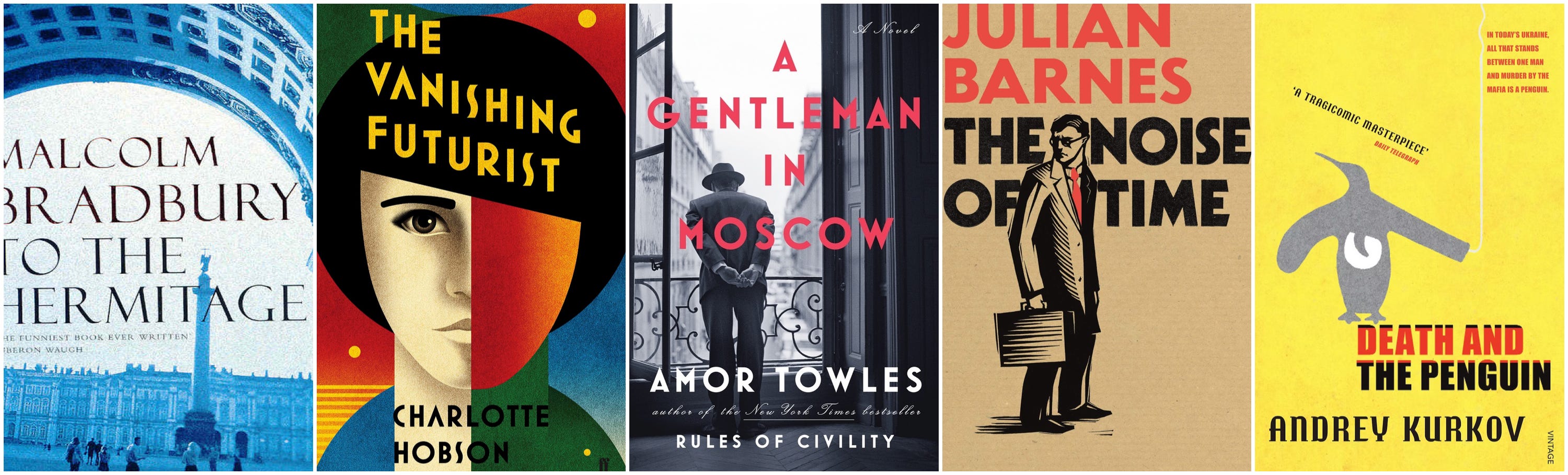
Malcolm Bradbury’s To The Hermitage (18thC and 1990s St Petersburg): Not to confused with his American namesake Ray, Bradbury is perhaps best known for inaugurating the UEA Creative Writing course in Norwich (from which the likes of Ian McEwan, Kazuo Ishiguro and Rose Tremain graduated). He was a fascinating and witty writer and this is no exception. Like the Frayn above, this straddles the 1990s and the eighteenth century, this time with a modern academic travelling to Stockholm and St Petersburg to trace the steps and impact of the French philosopher Denis Diderot in Catherine the Great’s court. Like some of the best books it’s impossible to describe since every attempt usually sounds dull. But it really isn’t!
-
Charlotte Hobson’s The Vanishing Futurist (Revolutionary Moscow): This perfectly captures the excitement and infectious optimism in those early months of the Russian Revolution. Everything was possible before the iron grip of commissars and Chekists spread throughout society. Gerty, a British governess who arrived in 1914, gets caught up in it all, and joins a thrilling commune of pioneering social experimenters. One is a bit of a mad inventor… but he soon disappears. Has he actually managed to invent a Time Machine?!
-
Amor Towles’ A Gentleman in Moscow (er… Moscow): People love this book and it’s not hard to see why, especially because it resonated coincidentally with Covid. An aristocratic White Russian is mistaken for a revolutionary poet and weirdly gets confined to a posh hotel in Moscow. He ends up staying for years, tracking with the first decades of Soviet Russia. He’s one of the most likeable characters in fiction, for all the implausibilities of the scenario and you end up simply wanting to hang out. This is a real delight.
-
Julian Barnes’ The Noise of Time (1930s Leningrad): Barnes is a favourite writer and Shostakovich is one of my all time artistic heroes. I was overjoyed they converged in this book, as Barnes fictionalises the composer’s private agonies under Stalin (he came of age just as Uncle Joe came to power). Famously, he would dress for the cold with an overnight case and wait outside his apartment for the KGB so that this family wouldn’t be disturbed by his arrest. Such a poignant book.
-
Andrey Kurkov’s Death and the Penguin (1990s Kyiv): Unexpectedly hilarious, this takes us to the other end of the Soviet experiment and its collapse in the early 90s. We’re in Ukraine (included in a previous 25) at a time when nobody could tell exactly how it would all pan out. The protagonist (a newspaper obituary writer) has to look after a penguin from Kyiv zoo because in the anarchy, there are no funds to keep it going. He gets into all kinds of scrapes with the mafia and the various competing forces and thus gives us a scary but funny window into chaos.
5 books: Out of the fog of war…
-
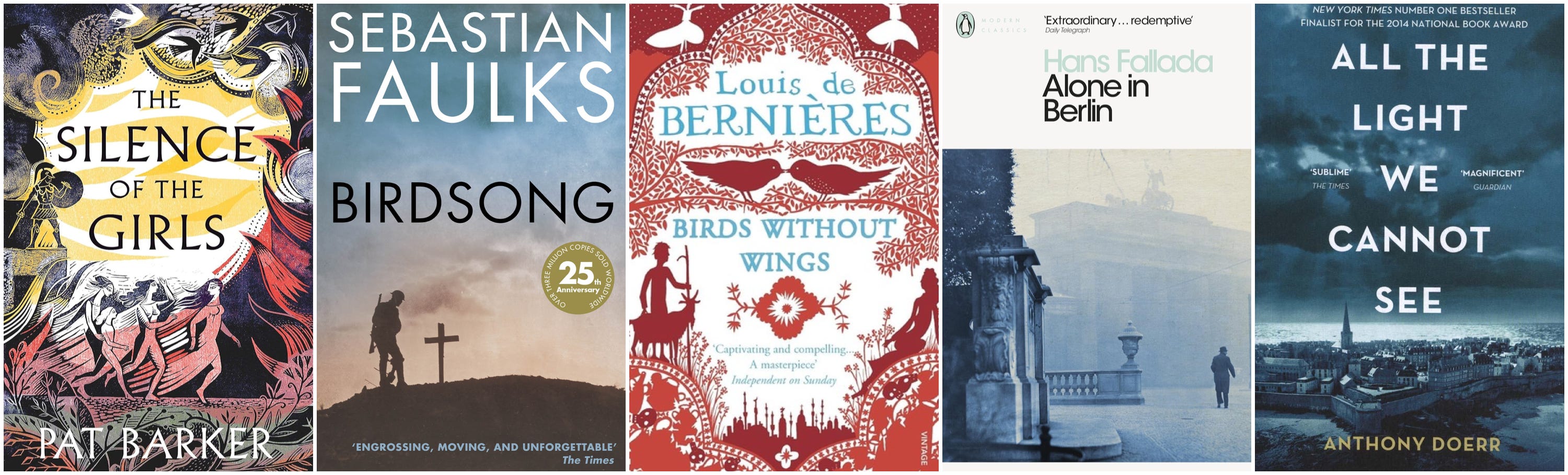
Pat Barker’s The Silence of the Girls (Mythical Greece & Troy): It’s become quite the vogue to revise ancient classical myths from more contemporary perspectives, but Pat Barker was one of the first and easily the best. This is the first of her trilogy inspired by Homer’s Iliad, but gives voices to the countless women who were mere possessions and barter in the ancient world (not to mention more recently). Briseis was Trojan royalty but is now Achilles’ concubine and slave. What makes it all the more galling is that Achilles had killed her husband and brothers. How will she cope? What can she do? Women’s suffering in wartime is vivid here. And Barker is a brilliant writer of wartime (I could easily have included her Regeneration trilogy here about the 1WW).
-
Sebastian Faulks’ Birdsong (France in 1WW): This was a gut punch of a book, with Faulks crafting a deeply affecting love story spanning three generations. We’re transported from the intensity of the relationship between an Englishman and French woman before the war to the grotesque horrors of the trenches on the Western Front.
-
Louis de Bernières’ Birds Without Wings (Türkiye in 1WW): The convulsions as the Ottoman Empire collapsed have been largely forgotten. But for millions they were as seismic as the partition of India after 2WW, with Greek-speaking Turks were forced to migrate east and Turkish-speaking Greeks west. The effects are still felt in the eastern Mediterranean over 100 years later. Perhaps it takes Brit of Huguenot extraction to write an historical novel admired both Greek and Turkish friends of mine. This will put the Gallipoli tragedies in context too. It is also the prequel to the better known Captain Corelli’s Mandolin, but I think this is the better book.
-
Hans Fallada’s Alone in Berlin (Germany in 2WW): After the Nazis come to power and Hitler has launched his wars of aggression, what on earth do you do to resist or protest? This was first written in 1947 but not translated into English until 2009 (in USA its title was a direct translation of the original, Every Man Dies Alone). Remarkably, it’s based on the true story of a couple, the Hempels, who simply distribute leaflets and postcards around the city urging resistance (spurred by the wife’s brother being killed in action).
-
Anthony Doerr’s All the Light We Cannot Sea (France in 2WW): Another fan favourite, this tells the story in occupied St Malo (on the Brittany coast) of Marie-Laure, a blind French girl, her museum curator father and a young German radio operator. It’s a surprisingly hopeful story beautifully told and like many on this list, it really sticks with you. It came out in 2014 and it became even more vivid in my mind after walking St Malo’s old city walls with a friend and colleague, Michael in 2017. Even better, Michael’s wife is called Marie-Laure.
4 responses
I am amazed that I’ve actually read and really enjoyed a significant number of these 25 books! And I, too, count John of Gaunt and Kate as ancestors through my mother’s line. Although my favourite nearer ancestor (apart from Mary Boleyn) is my great great grandmother who was called Elizabeth Bennett😊.
excellent!
I’ve read and loved 18 of these. Great to have the others as recommendations. I read Katherine in my early 20s and loved it so much! An Instance of the Fingerpost is probably my favourite historical novel of all.
yes! it’s unbeatable