

Having done one for Ukraine, I’m perhaps getting onto a bit of a roll. Friends know I’ve been working on a novel for the best part of 10 years now. It’s set in 1968 East Berlin, so whenever I spot books about the GDR (East Germany), I make a beeline. Here are some of my favourites (not exhaustive, scholarly, or authoritative!).
5 books: GDR Background History
-
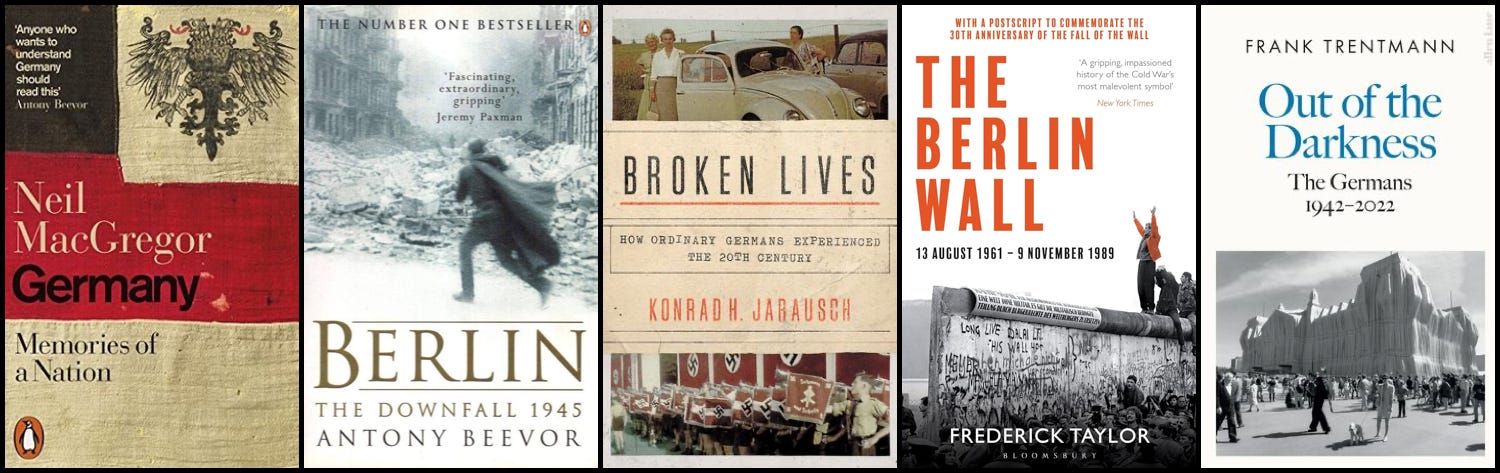
Neil MacGregor’s Germany: Memories of a Nation: A British art historian and former British Museum boss, MacGregor worked in Berlin for a number of years and wrote this survey focused on key objects from the country’s history to coincide with a major exhibition.
-
Antony Beevor’s Berlin: The Downfall 1945: Beevor is a renowned military historian, known especially for his history of the Battle of Stalingrad. This is a devastating account of how the European war ended with total German destruction. It’s impossible to understand subsequent events without this seismic event.
-
Konrad H. Jarausch’s Broken Lives: To be an ordinary citizen of Germany in the 20th Century was to experience extraordinary extremes, and this book reminds us that geopolitical machinations always have individual consequences.
-
Frederick Taylor’s The Berlin Wall 1961-1989: The construction of the wall was representative of both a society under totalitarian control and the utter failure of its ideology. If it was creating such a paradisiacal world, why was everyone so desperate to leave? Taylor’s history is a brilliant overview of how the wall came to be and what it meant, and ultimately, why it could never last.
-
Frank Trentmann’s Out of the Darkness: The Germans 1942-2022: A very recent addition, I’ve not read it all yet. But Trentmann considers how a country that went from total defeat to modern economic powerhouse, with all the rescue plans, compromises and dodgy deals that characterise modern politics.
5 books: History of the GDR
-
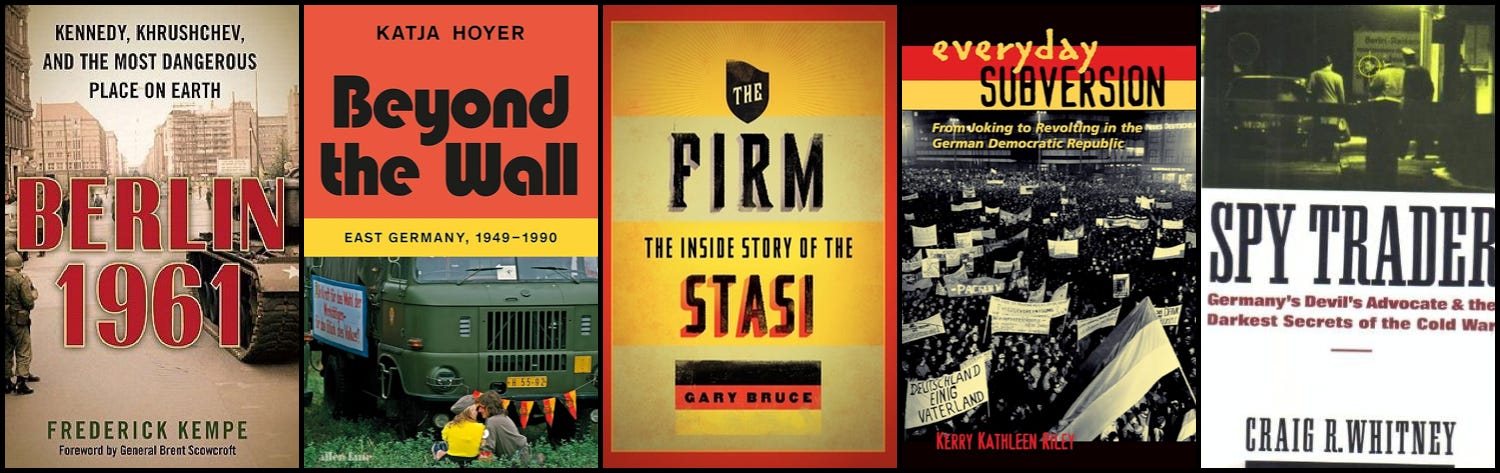
Frederick Kempe’s Berlin 1961: Kennedy, Khrushchev and the most dangerous place on earth: It is long forgotten, but before 1962 Cuban Missile Crisis, the world’s gaze was locked on Berlin where Soviet and US tanks faced each other off at Checkpoint Charlie. A brilliant account to trace the real jeopardy we all faced.
-
Katja Hoyer’s Beyond the Wall: East Germany 1949-1990: Hoyer grew up in East Germany and does an excellent job dispelling many myths and prejudices about life there; but for all its benefits, one can’t help feeling that many would have preferred they had come without the political realities of this insecure, little communist state.
-
Gary Bruce’s The Firm: The Inside Story of the Stasi: And the reason for that was the Communist Party’s (SED) sword and shield: the Stasi (secret police). It was a vast organisation with tentacles everywhere. They did know about pretty much everything; and what they didn’t know, they guessed (with varying degrees of success, mind). A relentless book.
-
Kerry Kathleen Riley’s Everyday Subversion: From Joking to Revolting in the GDR: an academic book with fascinating insights about what might be said, what went unsaid and what eventually was said. People have ingenious ways of navigating seemingly insurmountable odds.
-
Craig R Whitney’s Spy Trader: Germany’s Devil’s Advocate: this is one of the weirdest stories from the GDR, about one of East Germany’s most complicated and compromised characters, Wolfgang Vogel. A lawyer who worked with ease on both sides of the wall, he spent years as a go-between negotiator for prisoner releases and even ‘sales’…
5 books: Life in the GDR

-
Anna Funder’s Stasiland: Stories from behind the Berlin Wall: this is a classic and the perfect starting point if you need one. A decade after the country was reunified, Funder (an Australian journalist living in Germany) puts out ads to get volunteers to share their stories. Astonishing and very poignant.
-
Timothy Garton Ash’s The File: A Personal History: An Englishman’s account of returning to read his Stasi file a decade after spending 6 months doing PhD research in the East. He sets out to meet everyone mentioned in his file (including friends, informers and Stasi officers surveilling him). A superb meditation on memory and motivations, not least because he can triangulate what he remembers, what he wrote in his diary at the time and what he finds in the files.
-
Thomas Harding’s The House on the Lake: Harding delves into the history of his grandmother’s former house in Berlin (from which she fled when the Nazis came to power) after finding it derelict. He discovers that the 5 families have lived in it, mirroring the tumult of the German century.
-
Joel Agee’s Twelve Years: An American Boyhood in East Germany: this is a weird one. Joel Agee’s mother had been married to the writer James Agee, but after divorcing she married a German communist in Mexico. They moved to the Soviet sector after the war, and lived in what became the GDR for the next decade. When that marriage also failed they moved back to the USA. A unique outsider’s inside view.
-
Maxim Leo’s Red Love: The Story of An East German Family: a dumb title but an interesting story of different generations’ means of navigating incredibly difficult circumstances.
5 books: Fiction in the GDR
-
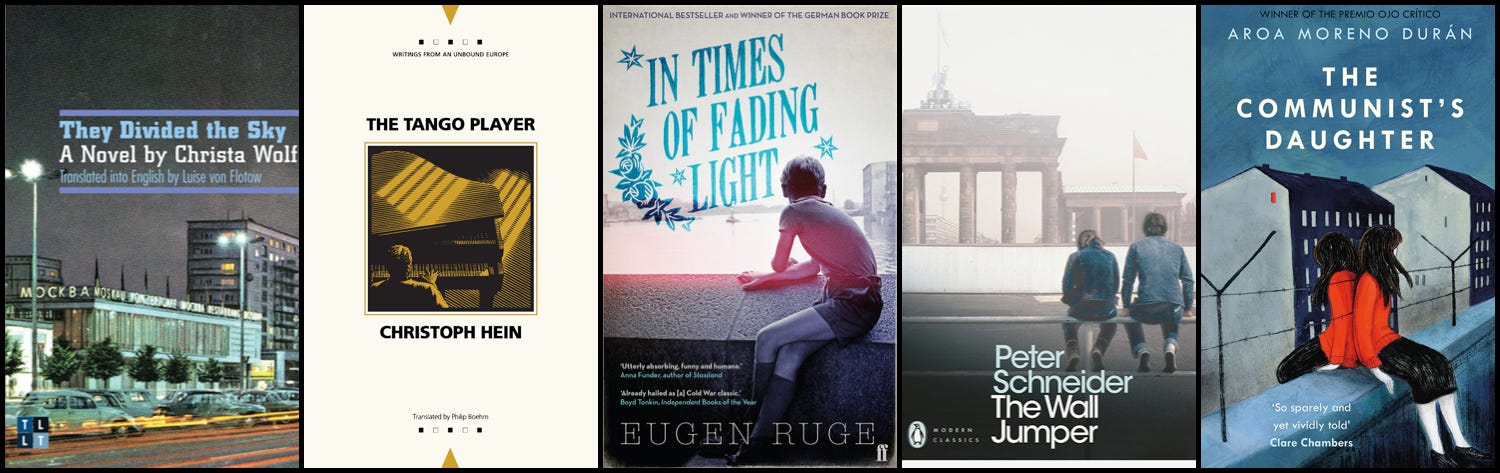
Christa Wolf’s They Divided The Sky: the Wall didn’t just split a country, it split people. Wolf was one of the most important writers in the GDR, and this compelling and moving novel was her breakthrough. She describes the splintering effects from the society’s tensions and surveillance with powerful insight.
-
Christoph Hein’s The Tango Player: set in Leipzig and strongly recommended to me by a friend who grew up in GDR Leipzig. A pianist tries to rebuild his life after nearly 3 years in prison (his only crime had been playing in a cabaret in which some subversive lyrics had been sung). For those in the State’s crosshairs, life could be brutal, absurd and maddening.
-
Eugen Ruge’s In Times of Fading Light: This time several generations are in view, and it’s not all grim and dark. There are moments of humour and levity as the protagonists find ways to survive and even build their resilience.
-
Peter Schneider’s The Wall Jumper: the two worlds in Berlin were never as hermetically sealed from one another as one might think and this novel tells of the various people who refused to be bound by either bricks and mortar or ideological constraints.
-
Aroa Moreno Durán’s The Communist’s Daughter: a Spanish language novel this time (in translation of course), and imagines the eponymous Katia discovering there is a whole world outside the one her ideologically driven father insists is sufficient. But her venturing out will have consequences inevitably.
5 books: The Church in the GDR
-
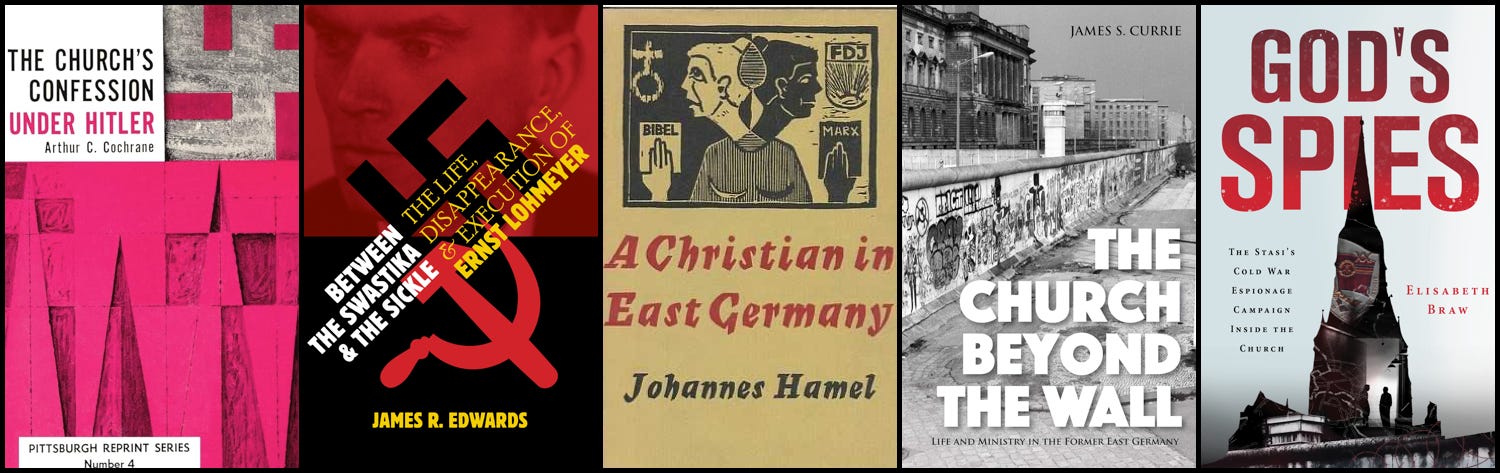
Arthur C. Cochrane’s The Church’s Confession under Hitler: Much is made of the effect of Dietrich Bonhoeffer and the Confessing Church (far more complex and inspiring in fact than Eric Metaxas would have us believe) and this is right. But they were so small. This book assesses what happened in many Nazi-era churches, and the legacy they left after the war.
-
James R. Edwards’ Between the Swastika and the Sickle: Those who had endured under Nazis in the Confessing Church were then well-tempered for the trials to come in the East. The GDR was the only predominantly Protestant country in the Communist East (a fact I find absolutely fascinating) and Ernst Lohmeyer was a truly remarkable man who went from the Nazi frying pan into the Red Fire and was killed. A truly remarkable man.
-
Johannes Hamel’s A Christian in East Germany: Hamel went about ministry in a lowkey way in the GDR and wrote some papers that were smuggled out and translated in 1961. I asked friends who grew up in the GDR and they’d never heard of him — but then how would they. There were no platforms for big Christian ‘names’ to gain a hearing. Hamel had a particular heart for university students. Amazing.
-
James S. Currie’s The Church Beyond The Wall: Currie puts Hamel into wider context and compares/contrasts his life and system navigation with that of Prof Hanfried Müller, a theologian who successfully played the system. The choice between suffering and success was stark and tested the mettle of everybody. This is a powerful account.
-
Elisabeth Braw’s God’s Spies: The Stasi’s Cold War Espionage Campaign Inside the Church: I mentioned that the Stasi knew everything. Well they had whole departments for different parts of society; that meant an entire Stasi department dedicated to infiltrating and eavesdropping on the Church. The impact was devastating, and far exceeds what people ever realised at the time.